
Many people believe discipline comes from motivation. They assume disciplined people feel energized, focused, and driven toward their goals.
In reality, motivation is temporary.
Motivation changes with stress, fatigue, mood, and life circumstances. When pressure increases, motivation is usually the first thing to fade.
But discipline operates differently.
Discipline is what remains when motivation disappears.
During periods of disruption or major life transitions, this difference becomes especially important. When life becomes uncertain or difficult, motivation often drops quickly. Discipline is what allows someone to continue moving forward.
Understanding this difference is central to the idea of transformational resilience.
Why Discipline Often Breaks Down
Many people believe they struggle with discipline because they lack willpower. In reality, the environment people live in today makes discipline harder to maintain.
Modern systems are built around constant stimulation and rapid feedback.
Technology provides instant entertainment. Social media platforms reward attention with quick responses. Digital systems are designed to keep people engaged through novelty and short bursts of information.
Each of these experiences activates dopamine, a neurotransmitter connected to reward and anticipation.
Over time, constant stimulation trains the brain to expect immediate payoff.
However, discipline operates on the opposite timeline.
Most meaningful progress requires sustained effort over long periods of time.
Learning a skill takes time. Developing a career takes time. Rebuilding stability after disruption takes time. Strengthening relationships takes time.
These outcomes depend on consistent behavior rather than short bursts of effort.
Discipline is the mechanism that makes that consistency possible.
The Long Timeline of Real Progress
In many Western cultures, success is often framed through visible outcomes.
Income, status, recognition, and lifestyle are commonly used as measures of progress.
These outcomes are not inherently negative, but they can distort how people understand growth.
When success is measured primarily through visible rewards, people begin to expect progress to happen quickly.
If results do not appear fast enough, many assume something is wrong.
In reality, most meaningful development occurs slowly.
Athletes train for years before reaching elite performance.
Professionals spend decades building expertise in their field.
Families rebuild stability through repeated decisions made over time.
None of these outcomes depend on motivation alone.
They depend on discipline.
Discipline Inside the C2R2E Framework
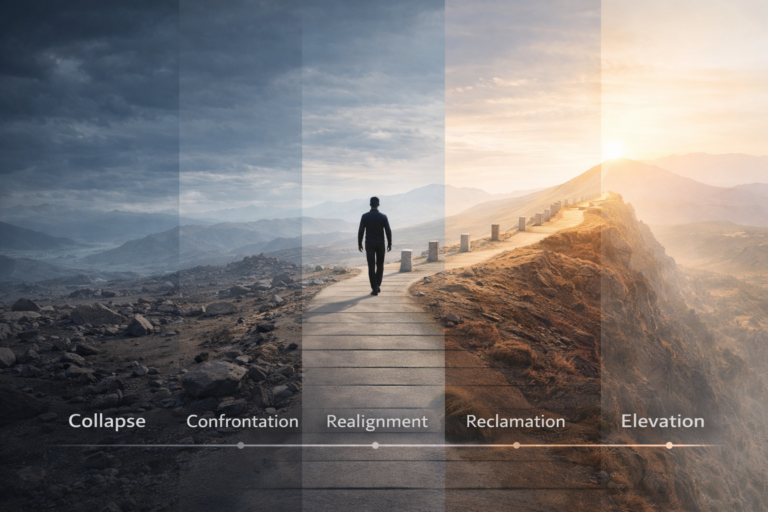
The Elevatus framework for transformational resilience is called C2R2E.
C2R2E represents five stages people often move through during major life transitions.
Collapse
Confrontation
Realignment
Reclamation
Elevation
- Collapse occurs when something in life stops working. A relationship may end, a career path may shift, or an existing life structure may break down.
- Confrontation is the stage where someone begins examining reality honestly and recognizing what led to the disruption.
- Realignment is where new direction begins to form.
- Reclamation is the period where stability and capability start rebuilding through consistent action.
- Elevation is where a stronger life structure begins to emerge.
Movement through these stages requires discipline.
Discipline allows someone to remain in confrontation long enough to understand the problem clearly.
It allows realignment to hold even when old habits attempt to return.
It supports the slow rebuilding process that happens during reclamation.
And once progress begins, discipline sustains elevation.
Without discipline, many people remain stuck between collapse and confrontation. They recognize the problem but struggle to maintain consistent action.
Discipline creates forward movement.
Why Motivation Alone Is Not Enough
Motivation can be helpful at the beginning of change.
It often provides the emotional energy required to start something new.
Motivation can help someone begin a new habit, pursue a new direction, or take the first step after disruption.
But motivation rarely survives the middle stage of any long process.
The middle stage is where progress becomes repetitive. Results may be slow. Feedback is often limited.
This is where many people stop.
Discipline allows progress to continue during this stage.
Instead of relying on emotion, discipline creates structure.
Structure reduces decision fatigue and makes progress repeatable.
The goal is not to feel motivated every day.
The goal is to maintain a system that continues working even when motivation disappears.
A Practical Exercise to Build Discipline
If discipline feels inconsistent in your life, start with a simple reset exercise.
First, identify one area of life that currently lacks structure.
This could be physical health, finances, professional development, personal organization, or communication within relationships.
Choose only one area.
Next, ask yourself a simple question.
What is one small action I could repeat every day for the next thirty days that would improve this area?
Choose an action that is simple and measurable.
Examples might include walking for fifteen minutes, practicing a skill for twenty minutes, writing one page of ideas, or reviewing finances for five minutes.
Once you select the action, commit to repeating it every day for thirty days.
Do not modify the action during this period.
The goal is not optimization.
The goal is consistency.
Some days the action will feel easy.
Some days it will feel inconvenient.
Those inconvenient days are where discipline develops.
Because discipline is not the ability to act when inspiration is present.
Discipline is the ability to continue when inspiration is absent.
Final Thought
Discipline is not a personality trait.
It is a behavior that develops through repetition.
Small consistent actions create structure. Structure creates stability. Stability creates momentum.
Over time, those repeated actions become the foundation for elevation.
🔄Did you find this article helpful? Share it!

About the Author - Danny DeJesus
Danny De Jesus is a transformational resilience thought leader, strategic thinker, and the founder of Elevatus Coaching—a practice built to help people rebuild their lives after major change. Drawing from his own experiences with divorce, co-parenting, and career shifts, he created the C2R2E Framework to guide people from collapse to elevation with clarity and confidence. Through the Elevatus Blog, he shares insights for anyone navigating disruption, rebuilding direction, or shaping a new chapter with purpose.