
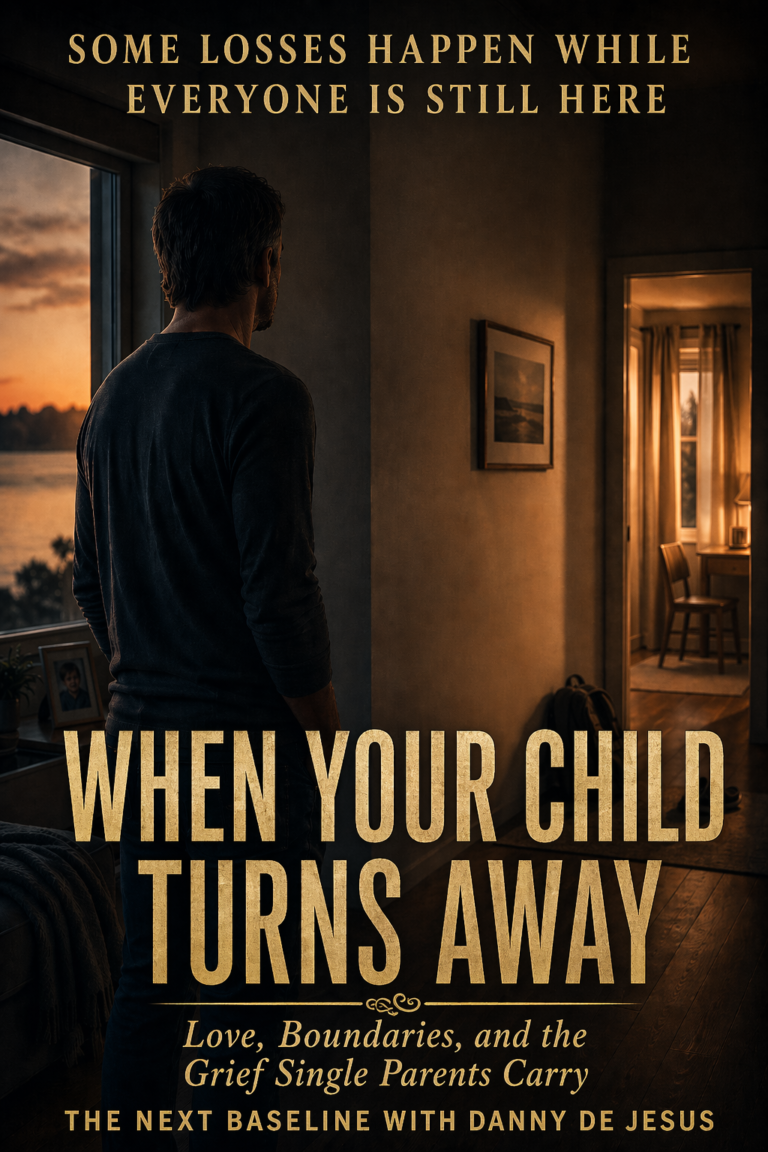
There is a kind of loss that does not get talked about enough, and that is the pain of becoming emotionally estranged from your own child. This is especially hard for single parents who did show up. You paid the child support. You made the drive. You picked them up on time. You spent the time. You stayed involved. Then one day, or what feels like overnight, your child starts saying they do not trust you, do not feel safe with you, do not want to talk, or do not want the relationship in the way you thought they did. That kind of rejection cuts deep because it is not just about parenting. It feels personal, and it creates a grief that is hard to explain unless you have lived it.
In many cases, it does not fully come out of nowhere. Sometimes the signs have been there for years. There may have been growing distance, tension, changed behavior, or repeated friction that slowly pointed in this direction. Then when it finally becomes direct, the parent is left carrying not only the pain of the moment, but also the weight of all the accusations that come with it. You may be told you are too strict, too hard, unsupportive, unsafe, emotionally harmful, or unwilling to listen. That leaves many parents trying to sort through what is true, what is distorted, what may be influenced by others, and what they are supposed to do next.
This is where many parents begin searching for answers. They start reading about estrangement, alienation, emotional cutoff, and damaged parent-child relationships. But one of the hardest truths to accept is that unconditional love does not mean endless concession. You can keep your door open and still refuse to build a one-way relationship. You can love your child deeply and still decide that gifts, vacations, purchases, and special treatment are not the answer when the relationship itself is being rejected. Love can remain, while boundaries remain too. An open door does not mean the parent has to keep begging, chasing, or overextending to hold onto a bond that cannot be forced by one person alone.
Sometimes the next baseline is not fixing the relationship right away. Sometimes it is accepting the reality of the moment, protecting your peace, and continuing to live your life without closing your heart. That is not abandonment. That is clarity. It means staying available in a healthy way, loving your child without conditions, and also recognizing that you cannot do the work of two people. For the single parent carrying this kind of grief, that may be one of the hardest lessons of all. You can remain open. You can remain steady. But you also have to stop letting rejection consume your entire identity and emotional world.
🔄Did you find this article helpful? Share it!

About the Author - Danny DeJesus
Danny De Jesus is a transformational resilience thought leader, strategic thinker, and the founder of Elevatus Coaching—a practice built to help people rebuild their lives after major change. Drawing from his own experiences with divorce, co-parenting, and career shifts, he created the C2R2E Framework to guide people from collapse to elevation with clarity and confidence. Through the Elevatus Blog, he shares insights for anyone navigating disruption, rebuilding direction, or shaping a new chapter with purpose.