
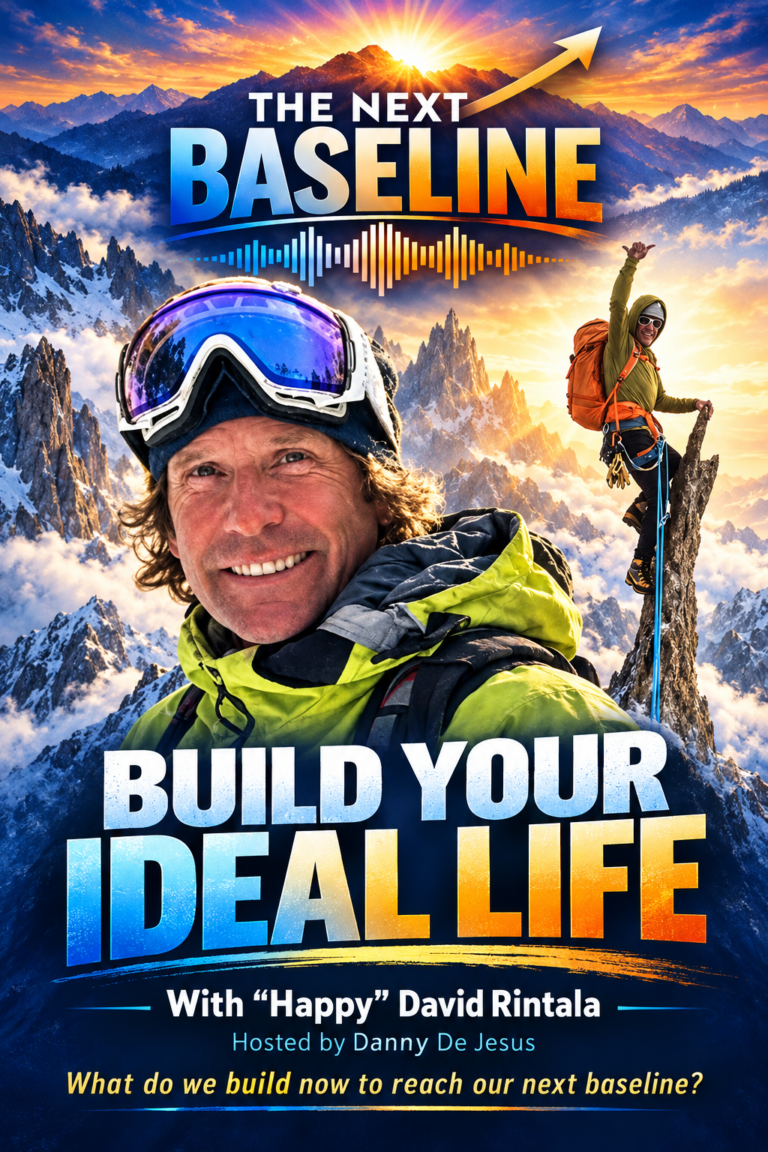
“Discontent breeds evolution.”
David “Happy” Rintala
Featured Guest: David "Happy" Rintala
You can spend years pursuing a goal, achieve it, and discover that the everyday life attached to it leaves little room for what you actually wanted.
That possibility stayed with me after my conversation with David “Happy” Rintala on The Next Baseline. His story begins with a teenager living in a van at a ski resort, earning $5.25 an hour cleaning the lodge at night. It grows into a career building adventure businesses across Alaska, Lake Tahoe, and Hawaii, including helicopter skiing, skydiving, rafting, and mountain biking.
It is an exciting story of ambition and possibility. But the deeper value of our conversation came from examining how we choose our goals, what those goals demand, and whether the lives we build continue to reflect what matters to us.
Happy’s experience offers a question worth considering before your next major decision:
Do you want the life that comes with the goal you are pursuing?
The Opportunity Inside Discontent
When Happy said, “Discontent breeds evolution,” I connected with that immediately.
As I prepare to transition from more than two decades of military service, I understand the uncertainty of looking beyond a familiar structure. You can be experienced, capable, and confident in your current environment while still wondering where you belong next.
During our conversation, I suggested that getting unstuck sometimes requires making a decision and taking a step forward. Happy added an important consideration: allow yourself enough time to understand the available paths before committing to one.
He described transition through the image of light passing through a prism. A direction that once seemed straightforward opens into several possible futures. Each leads somewhere different, and the responsibility of choosing can feel overwhelming.
His invitation was to remain in that uncertainty long enough to learn from it.
That perspective matters because making a decision can bring immediate relief without resolving the questions beneath it. We may feel better because we have chosen something, even if we have not examined where that choice will take us.
A thoughtful pause creates room to ask: What am I moving toward? What will this decision require? Does this direction reflect what I want, or simply what feels familiar?
Before Realignment Comes Honesty
This is where our conversation connected naturally with C2R2E: Collapse, Confrontation, Realignment, Reclamation, and Elevation.
Collapse can begin with the recognition that something is no longer working. It may arrive through a major disruption, but it can also emerge through recurring dissatisfaction, exhaustion, or the feeling that your life has become disconnected from your priorities.
During the episode, I described this as a time to take in information. What are your experiences telling you? What keeps resurfacing? What have you been trying to explain away?
Confrontation means facing what that information reveals.
You may discover that the career you once wanted no longer fits. You may recognize that a business is consuming the freedom it was supposed to create. You may realize that your definition of success has changed while your commitments have remained the same.
Those realizations deserve attention. They give realignment a foundation grounded in your actual circumstances.
Without that honesty, it is easy to carry the same assumptions into a new situation and recreate the dissatisfaction you hoped to leave behind.
Do You Want the Bookstore—or Do You Love Books?
One of Happy’s most useful observations was also one of his simplest:
“If you love books, you may not want a bookstore.”
Loving books and operating a bookstore involve very different daily experiences. One might mean reading, learning, writing, or exploring ideas. The other includes inventory, staffing, overhead, opening hours, and responsibility for keeping a business running.
Both can be fulfilling. The question is whether the responsibilities match the desire.
Happy illustrated this distinction through the story of a client who wanted to build a retreat center in Costa Rica. According to Happy, the client believed he needed a million dollars to purchase property and get started.
Further conversation revealed that his underlying desire was to travel the world and lead retreats.
Owning a retreat center would tie him to a location, require property maintenance, and create financial obligations. The plan he had imagined could have restricted the freedom he wanted.
Happy described helping him redesign the idea around renting existing retreat spaces in different locations. He reported that the client spent $400 on a website and hosted a profitable first retreat within their initial 90 days together.
The value of that story lies in the clarification that changed the plan.
The client had connected his desired life to one particular business model. Once they examined that connection, another route became possible.
We make similar assumptions in our own lives. We pursue a title because we want influence, a business because we want autonomy, or a move because we want a fresh start. The next step is to examine whether the option we have chosen can provide the experience we are seeking—and what it will ask of us in return.
Give Your Vision an Everyday Reality
Happy’s Life Expanded process begins with imagining possibilities and then clarifying them. He explained that the early weeks of his 90-day process often involve helping participants understand what they truly want.
That distinction between imagining and clarifying is essential.
Imagination gives us permission to consider a life beyond our current circumstances. Clarification brings that vision into everyday reality.
What would your mornings look like? What responsibilities would fill your calendar? How much flexibility would you have? What would you need to maintain, manage, or sacrifice?
An ideal life becomes more meaningful when we can describe how we want to experience it.
Freedom might mean choosing your working hours. Fulfillment might mean doing work that uses your strengths. Success might include financial security alongside time for relationships, health, travel, or creativity.
The clearer we become about those experiences, the better equipped we are to evaluate the opportunities in front of us.
Success Still Requires Realignment
Happy’s own story shows that this examination continues after a goal has been achieved.
He described his approach as passion entrepreneurship: building businesses around experiences he enjoyed. Yet as those businesses expanded, the demands grew, and burnout became part of the picture.
Even an adventure business can leave its owner with little time for adventure.
Happy spoke about making himself get on the helicopter and participate in the experience he had built his work around. He also described restructuring his business interests, handing off certain operations, and focusing on the areas that better supported his enjoyment and profitability.
Through C2R2E, I see reclamation in those choices.
Reclamation involves recovering your ability to participate in your own life. That may mean reclaiming time, changing responsibilities, or making room for interests that have been crowded out by everything you manage.
Elevation then asks what improvement means for you now. Sometimes it means expansion. Sometimes it means simplifying what you have built so that it serves your life more effectively.
The measure deserves to include how you live, alongside what you accomplish.
Let Stability Support Your Next Step
Toward the end of our conversation, Happy offered another perspective that stood out:
“Your job is like your first investor in your future.”
For someone navigating a career transition, that idea creates room for a practical beginning. Existing stability can support exploration while you develop a clearer direction.
A next step might be an informational conversation, a small project, a new skill, or a limited experiment that helps you test an assumption.
Those actions give you information. They help turn an imagined possibility into something you can evaluate through experience.
You can begin with the time, resources, and responsibilities you have today. What matters is choosing a step that helps you understand and move toward the life you want.
What Life Are You Actually Building?
Happy’s story invites us to imagine boldly while remaining willing to question our plans.
His journey from cleaning a ski lodge to building adventure businesses is compelling. Equally valuable is his recognition that success requires ongoing attention to what makes life fulfilling.
Before pursuing your next goal, consider the everyday life waiting on the other side of it.
Would you want its ordinary Tuesday? Would its responsibilities support the freedom you seek? Would there be room for relationships, enjoyment, and the parts of yourself that work cannot contain?
Your answers may reinforce your direction. They may also reveal that the goal needs to change.
Either discovery gives you something useful to build from.
What do we build now to reach our next baseline?
Listen to the Full Conversation
This Elevatus Editorial accompanies a conversation with David “Happy” Rintala on The Next Baseline podcast, exploring how clarifying what we truly want, questioning the limits we assume, and redefining success can help us move beyond feeling stuck and build a life with greater purpose, freedom, and joy.
 Listen to the full episode below.
Connect with Happy
Explore Happy David Rintala’s work and Life Expanded process at IVOLVguide.org, or connect with him on Instagram at @happyisstoked.
🔄Did you find this article helpful? Share it!

About the Author - Danny DeJesus
Danny De Jesus is a transformational resilience thought leader, strategic thinker, and the founder of Elevatus Coaching—a practice built to help people rebuild their lives after major change. Drawing from his own experiences with divorce, co-parenting, and career shifts, he created the C2R2E Framework to guide people from collapse to elevation with clarity and confidence. Through the Elevatus Blog, he shares insights for anyone navigating disruption, rebuilding direction, or shaping a new chapter with purpose.