
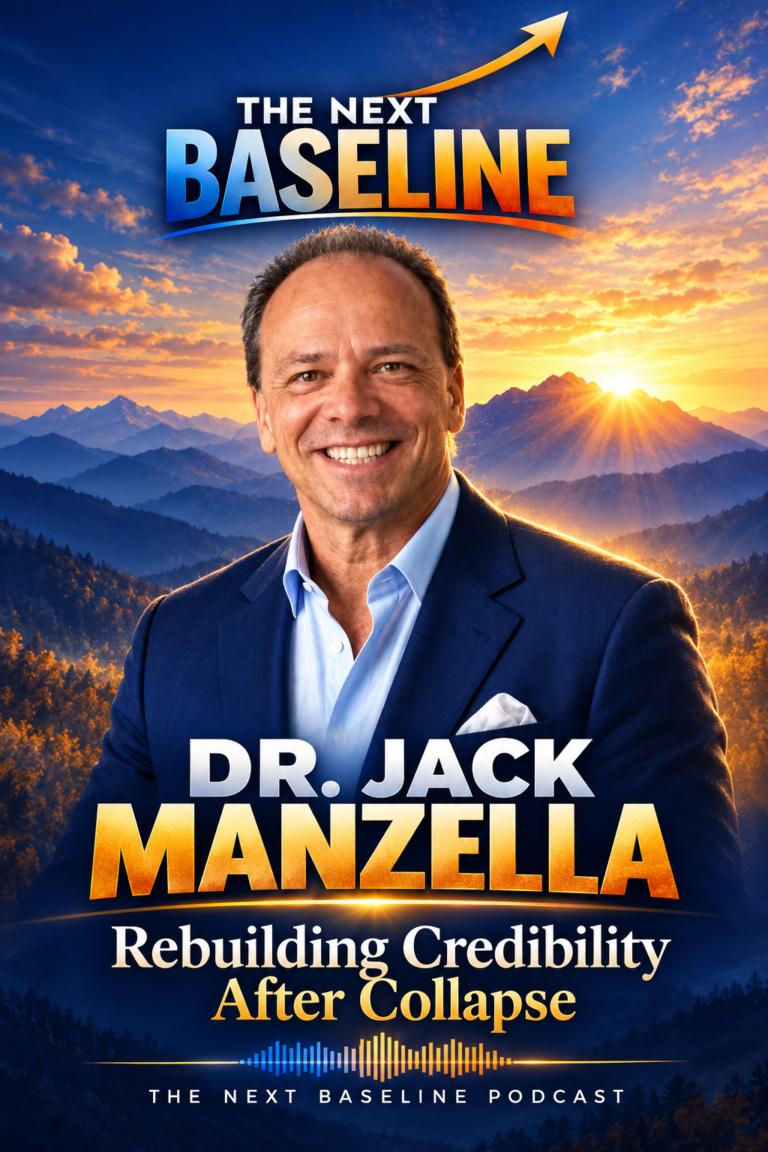
“The work is daily and the work is minute by minute.”
Dr. Jack Manzella
Featured Guest: Dr. Jack Manzella
There are moments in life when everything we have built begins to fall apart. Sometimes those moments arrive without warning. We lose a job, a marriage ends, our health changes, or circumstances beyond our control force us to reconsider the future we once imagined.
But what happens when the collapse is the result of our own decisions?
What happens when the person responsible for destroying the life we worked so hard to build is the same person looking back at us in the mirror?
This was the difficult territory I explored with Dr. Jack Manzella during our conversation on The Next Baseline.
Dr. Manzella spent more than three decades working in healthcare as a physician, educator, and leader. He had professional standing, a family, and a reputation that took years to establish. Yet behind that success, he was making decisions that would eventually cost him his medical license, his marriage, his freedom, and the trust of people closest to him.
His story includes substance abuse, serious professional misconduct, criminal convictions, and two years in federal prison. It also includes the long and uncomfortable process of accepting responsibility, rebuilding relationships, returning to medicine, and finding purpose beyond professional recognition.
What interested me most wasn’t simply that Dr. Manzella found a way forward. It was everything that happened between losing his former life and beginning to build another.
Because the messy middle of transformation is where much of the work actually takes place.
When Your Profession Becomes Your Identity
Dr. Manzella’s relationship with professional identity began long before he entered medical school.
Born into an Italian Catholic family, he grew up watching his father become an orthopedic surgeon. That achievement brought a certain standing within their community. As Dr. Manzella explained, he wasn’t always seen simply as Jack. He was known as the doctor’s son.
Medicine became more than a career opportunity. It became part of the family’s identity, expectations, and reputation.
As he grew older, Dr. Manzella followed that path. He performed well academically, became a physician, taught medical students, and established himself professionally.
But there was another side to his life.
He described drinking and using drugs from a young age, while continuing to perform well in school and sports. His success made it easier to overlook the warning signs. Over time, alcohol became something he relied on to sleep, while stimulants helped him get through the next day.
The distance between the image he presented and the choices he made continued to grow.
That distinction matters because professional success can sometimes hide personal deterioration. A person may continue meeting expectations at work while struggling with serious problems outside public view.
In Dr. Manzella’s case, those struggles eventually extended into his professional conduct.
He acknowledged having a sexual relationship with a patient, violating the ethical boundaries of the physician-patient relationship. He also described improperly prescribing narcotics in efforts to keep people quiet and protect himself from the consequences of his behavior.
These were serious breaches of trust that affected more than his personal reputation. They involved patients, professional responsibilities, and conduct that contributed to a larger public health problem.
Eventually, federal investigators entered his medical office and arrested him.
The professional identity he had spent a lifetime building was coming apart.
The Collapse Was More Than Losing a Career
When people discuss life transitions, they often focus on the event that caused everything to change.
The job loss. The divorce. The diagnosis. The arrest.
But the event itself is only one part of the story.
Dr. Manzella described losing his standing in the community, his ability to practice medicine, and the relationships that once gave his life structure. His conduct also brought consequences for his family and professional colleagues.
He was sentenced to prison, and the life he had known was no longer available to him.
What stood out during our conversation was how deeply he had connected his worth to being a physician.
When that identity disappeared, he struggled to understand who he was without it.
This is where his experience connects with a central question I explore through Elevatus Coaching and The Next Baseline: Who are we when the roles, responsibilities, and accomplishments that once defined us are no longer there?
For some people, that question emerges during retirement or a career transition. For others, it comes after a marriage ends or an unexpected loss.
For Dr. Manzella, it emerged through a collapse that he had helped create.
And unlike a transition where we can place responsibility entirely on circumstances, his path forward required something particularly difficult.
He had to confront himself.
Confrontation Begins When the Excuses End
One of the most important distinctions within my C2R2E framework is the difference between experiencing a collapse and confronting its reality.
Collapse is what happens when the life we know can no longer continue as it was.
Confrontation requires us to examine what happened, what remains, and what responsibility we carry into the future.
Dr. Manzella described how his early response to trouble included denial, defensiveness, and attempts to protect his reputation. Those behaviors had served him in the past, at least temporarily.
But eventually, he could no longer talk his way around the consequences.
While incarcerated, he began participating in a Christian fellowship and observing men who seemed to possess a sense of peace that he could not understand.
Some faced lengthy prison sentences, yet appeared to have found a different way to live.
He wanted to understand how that was possible.
The answer wasn’t a dramatic breakthrough. It began with small acts of discipline and honesty.
He learned to keep his living space clean, make his bed, read, pray, and take responsibility for the decisions directly in front of him.
These actions might sound ordinary, but within the larger story, they represented something significant.
For a man who had spent years manipulating circumstances and avoiding consequences, learning to make honest decisions without expecting immediate rewards was a change in how he approached life.
He was beginning to realign his values with his behavior.
The Work That Happens When Nobody Is Watching
During our conversation, I asked Dr. Manzella to explain what doing the work actually looks like.
We hear that phrase often in conversations about healing, recovery, personal growth, and transformation.
But what does it mean beyond the motivational language?
For Dr. Manzella, the answer was found in daily routines.
He described waking up earlier than necessary to make time for prayer, exercise, journaling, and personal reflection. He admitted that he frequently doesn’t feel like doing those things.
He would often prefer to remain in bed.
Yet he continues because his recovery is not something he considers finished.
He also described reviewing his behavior through practices learned in Alcoholics Anonymous, examining how he responded to people and where he needed to do better.
Progress, he explained, rarely arrives through one defining moment.
Sometimes, it becomes visible only when we look back and recognize that the decisions we make today are different from those we made months or years earlier.
That is an important lesson for anyone navigating a major life transition.
We often want change to happen quickly because the discomfort of our current circumstances is difficult to tolerate. We want the new career, the repaired relationship, the restored confidence, or the next chapter to begin immediately.
But transformation does not operate according to our preferred timeline.
Sometimes, the work is simply doing what we said we would do, especially when we don’t feel like doing it.
An Apology Does Not Erase the Consequences
One of the more meaningful parts of our conversation centered on forgiveness and making amends.
While incarcerated, Dr. Manzella worked on statements that required him to consider his conduct from the perspective of those harmed.
In particular, he confronted his role in improperly prescribing narcotics during a period when opioid misuse was devastating individuals and communities.
This required him to acknowledge that his decisions could have affected lives in ways he would never fully understand.
He also began reconsidering what it meant to apologize.
Earlier in his life, he often approached apologies as transactions. He wanted to say he was sorry, receive forgiveness, and return to normal.
But he eventually recognized that an apology does not create an obligation for another person to forgive us.
Nor does forgiveness, when offered, eliminate the consequences of wrongdoing.
He began practicing what he calls living amends.
Rather than repeatedly telling people he had changed, he focused on showing that change through his actions over time.
This is an important distinction.
Trust is not something we can demand because we have decided to become better people. Other people have their own experiences, memories, and reasons for remaining cautious.
We can take responsibility for our behavior. We can make sincere efforts to repair harm. We can change how we live.
But we cannot control whether someone else is ready to trust us again.
Sometimes, rebuilding credibility requires learning to live with that uncertainty.
Rebuilding Relationships on Someone Else's Timeline
Dr. Manzella’s professional collapse also affected his family.
He described the pain of telling his children that he was going to prison and recognizing that his own actions had damaged their sense of security.
His relationships with his children did not recover all at once.
He shared that his relationship with his sons is now strong, but his daughter remained distant for several years. There was a period of approximately two years when she would not communicate with him.
He continued acknowledging birthdays and holidays, even without receiving responses.
When he attended her events, he sometimes remained quietly in the background rather than approaching her and forcing an interaction.
He wanted to remain present while respecting the distance she needed.
It took roughly five years before a meaningful opening emerged. During a Christmas conversation, his daughter responded to him, beginning a gradual process of reconnection.
Even then, he had to resist the temptation to push for more contact than she was ready to give.
Today, he describes their relationship as strong, but he recognizes that reconciliation required patience.
His relationship with his former wife remains different. Their communication is limited and largely focused on practical matters.
That contrast is important.
Not every damaged relationship returns to what it once was. Some relationships improve. Others remain distant. And some may never be restored.
Through C2R2E, reclamation does not mean recovering every relationship or opportunity we lost.
Sometimes it means accepting what is possible today while continuing to act according to the person we are trying to become.
When Your Experience Becomes a Way to Serve Other
One of the unexpected developments in Dr. Manzella’s rebuilding journey was his entry into public speaking.
He explained that a former colleague named Shelba, who had worked with him in a rural primary care education program, gave him an opportunity to speak to medical students after he had made amends.
At the time, he was still working at UPS.
He stood before students and described the decisions that had led to his professional collapse. Rather than presenting himself as someone who had already achieved a complete comeback, he shared the reality of where he was.
That first opportunity eventually led to additional presentations.
Today, through Rock Bottom Doc, Dr. Manzella speaks with healthcare professionals, students, and other audiences about decision-making, accountability, recovery, and the consequences of crossing ethical boundaries.
His message has grown beyond medicine because these challenges are not limited to physicians.
Everyone makes decisions. Everyone has values they can either honor or compromise. And everyone faces moments when the next decision matters.
What interested me was how his work developed from an effort to make amends into an opportunity to help others recognize warning signs before they make similar mistakes.
He cannot change what happened.
But he can use what he has learned to encourage better decisions in the lives of others.
And perhaps that is one of the clearest examples of elevation.
Understanding the Journey Through C2R2E
Throughout our conversation, I kept returning to the five stages of C2R2E: Collapse, Confrontation, Realignment, Reclamation, and Elevation.
Dr. Manzella’s experience offers a useful example of how those stages can unfold over many years rather than in a predictable sequence.
His Collapse involved the loss of his medical career, freedom, family stability, and professional identity.
His Confrontation required acknowledging serious wrongdoing and accepting that the damage extended beyond himself.
His Realignment emerged through sobriety, faith, discipline, honesty, and a different understanding of personal responsibility.
His Reclamation continues through his relationships, restored medical practice, and efforts to rebuild professional credibility.
And his Elevation is taking shape through his speaking, service, and desire to help people make better decisions before their lives reach a similar breaking point.
But what makes this story meaningful is that Dr. Manzella does not describe himself as someone who has finished the process.
He still faces setbacks. He still encounters criticism. He still has goals he cannot yet pursue.
The work continues.
And that reminds us that C2R2E is not simply about reaching a better destination.
It is about developing the capacity to navigate life’s transitions with greater awareness, responsibility, and intention.
Your Next Baseline May Not Look Like Your Old Life
There is a temptation to judge a successful comeback by how much of the past someone manages to recover.
Did they regain their career? Did the family reunite? Did their reputation return? Did everything eventually work out?
But those questions can overlook something far more important.
Who has the person become along the way?
Dr. Manzella’s story is not an argument that every mistake deserves forgiveness or that every consequence should eventually disappear. The harm caused by serious misconduct remains part of the story, and accountability must remain part of the rebuilding process.
Instead, his experience raises a different possibility.
A person can accept responsibility for the past without deciding that the past is the only part of life that matters.
Rebuilding may begin with something as ordinary as getting out of bed, keeping a commitment, making an honest decision, or respecting another person’s boundaries.
Those choices may not produce immediate recognition or reward.
Yet repeated over time, they can become the foundation for a different life.
And perhaps that is what reaching a new baseline is really about.
Not pretending the collapse never happened.
Not demanding that the world restore everything we lost.
But recognizing where we stand today, confronting what brought us here, and taking responsibility for what we choose to build next.
Because the next baseline is not necessarily a return to the life we once had. Sometimes, it is the beginning of a life we are finally prepared to live differently.
Listen to the Full Conversation
This Elevatus Editorial accompanies my conversation with Dr. Jack Manzella on The Next Baseline, where we explore the realities of life transitions and the work required to move from collapse toward reclamation and elevation.
 Listen to the full episode below.
Connect With Dr. Jack Manzella
Dr. Jack Manzella is a physician and speaker who shares his experience through Rock Bottom Doc, addressing personal accountability, recovery, decision-making, and rebuilding professional credibility.
You can learn more about his speaking engagements, workshops, and work through the following channels:
Website: Rock Bottom Doc
Instagram: @therockbottomdoc
🔄Did you find this article helpful? Share it!

About the Author - Danny DeJesus
Danny De Jesus is a transformational resilience thought leader, strategic thinker, and the founder of Elevatus Coaching—a practice built to help people rebuild their lives after major change. Drawing from his own experiences with divorce, co-parenting, and career shifts, he created the C2R2E Framework to guide people from collapse to elevation with clarity and confidence. Through the Elevatus Blog, he shares insights for anyone navigating disruption, rebuilding direction, or shaping a new chapter with purpose.