
Most people trying to build something on their own are not failing because they lack discipline, intelligence, or effort. They fail because their work is not supported by a system.
In a one-person business, motivation cannot carry the load. Personal drive fluctuates, attention fragments, and capacity has limits. What holds the business together is not effort, but structure.
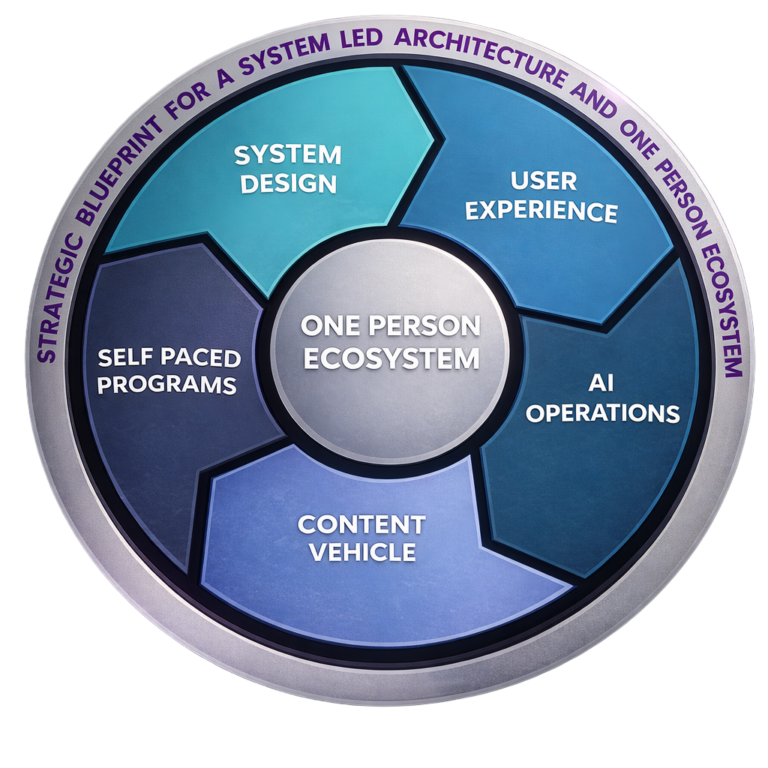
The model shown above is the structural framework I designed to address this problem. I call it the One Person Ecosystem.
The ecosystem is built around a single organizing principle: every component must belong to one coherent system. When tools, tactics, and platforms are added without a unifying structure, they create friction instead of leverage. Over time, that fragmentation becomes the primary source of exhaustion and instability.
Once structure is acknowledged as the stabilizing force, the question becomes practical.
What belongs in the system?
What does not?
What prevents unnecessary complexity from accumulating?
What allows the business to operate without constant correction?
Those decisions are made at the system design level.
System Design
System design comes first because it determines what exists and what does not.
This is where scope, sequencing, constraints, and boundaries are defined. Without system design, components are added reactively in response to pressure or opportunity. The result is more work without better outcomes.
This layer answers foundational questions:
- What problem does this ecosystem solve?
- What does not belong here?
- What must happen manually and what can be systematized?
- What is the minimum structure required to support long-term operation?
System design limits overbuilding and prevents burnout by constraining the system to what is necessary.
Structural Elements
The One Person Ecosystem is built from a small set of interdependent components. Each one reduces reliance on real-time effort.
Proprietary Logic
The reasoning that guides all decisions, offers, and content.Self-Paced Programs
Free and paid resources that operate without live delivery.Diagnostic Assessments
Entry points that allow people to self-select appropriate pathways.Content Vehicle
A consistent cadence of blogs, posts, and newsletters that compound over time.Email Capture and Newsletter System
Automated lead capture and ongoing communication without manual follow-up.User Experience and Navigation
Clear pathways that allow people to orient themselves without explanation.Design System
Intentional use of layout and visual hierarchy to reduce cognitive load.
These elements operate at different levels, but only function when subordinated to the system design that governs them.
…
User Experience
User experience is not about aesthetics. It is about clarity and cognitive load.
A one-person ecosystem must be easy to move through for both the audience and the creator. This layer focuses on how someone enters the system, how they understand what is offered, and how they know what to do next without assistance.
Confusion creates friction. Friction increases support demands and reduces trust. A clear user experience minimizes reactive communication and preserves attention.
AI Operations
AI operations exist to reduce decision fatigue and repetitive labor.
This layer supports drafting, synthesis, analysis, organization, and iteration. It does not replace judgment or thinking. It protects them.
When AI is integrated deliberately, it stabilizes output and preserves energy. When it is added without structure, it becomes another source of noise.
AI should be invisible to the audience and essential to the operation.
Content Vehicle
A content vehicle creates continuity by linking individual pieces of work into a single, cumulative system. At Elevatus, this vehicle is long-form written content.
Blogs, newsletters, supporting posts, and internal documents are not treated as standalone outputs. Each piece is written to reinforce prior work, clarify existing ideas, and extend the same line of reasoning over time. This allows understanding and trust to build incrementally rather than restarting with every new publication.
Without a defined content vehicle, writing becomes repeated effort. Ideas are reintroduced, context is lost, and progress resets. A clear vehicle ensures that content retains value, compounds over time, and continues working without requiring constant re-explanation.
Self Paced Programs
Self-paced programs are where the ecosystem becomes durable.
They allow knowledge, reasoning, and process to exist independently of real-time availability. Their purpose is not volume growth or speed. Their purpose is continuity.
These programs reduce reliance on constant presence and make the scope of the work explicit. They convert experience into reusable structure that can operate without ongoing intervention.
The Outcome
With this structure in place, my time is focused where it creates the most value: developing ideas, writing long-form content, and engaging directly with clients when judgment and context matter.
The rest of the Elevatus operates through systems that do not require continuous involvement. Because the architecture already exists, expansion does not require rebuilding. New work can be added without increasing daily operational load.
I am sharing this model to reduce the amount of trial and error required to reach this point. Review where your work depends on real-time presence. Identify what can be captured, structured, or delivered without you. Build systems that support your work rather than competing with it.
🔄Did you find this article helpful? Share it!

About the Author - Danny DeJesus
Danny De Jesus is a transformational resilience thought leader, strategic thinker, and the founder of Elevatus Coaching—a practice built to help people rebuild their lives after major change. Drawing from his own experiences with divorce, co-parenting, and career shifts, he created the C2R2E Framework to guide people from collapse to elevation with clarity and confidence. Through the Elevatus Blog, he shares insights for anyone navigating disruption, rebuilding direction, or shaping a new chapter with purpose.