
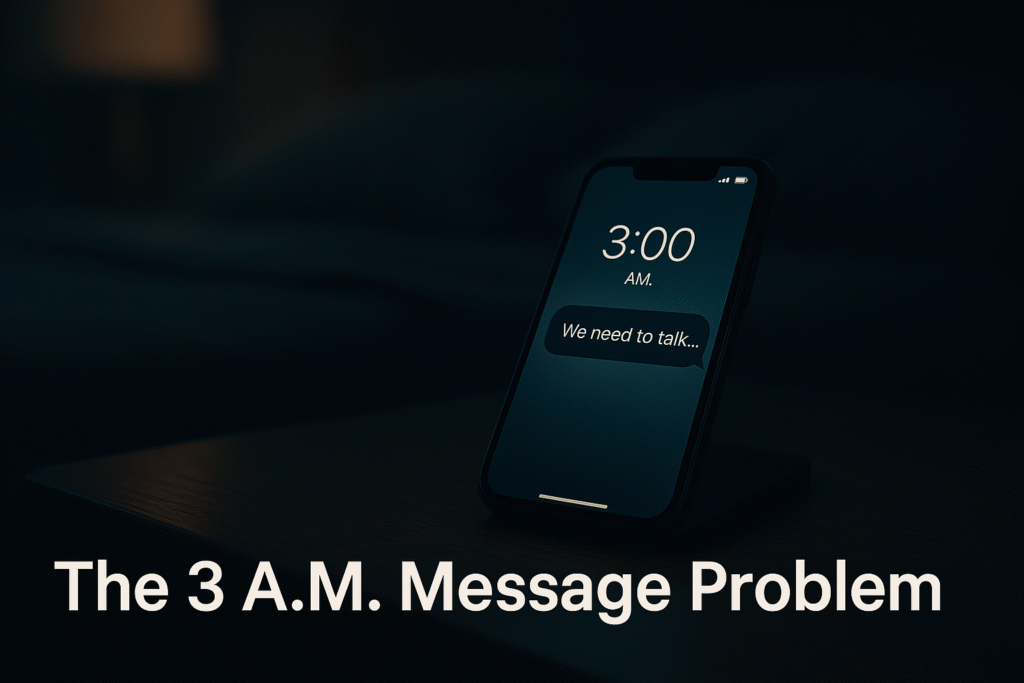
There are two types of late-night texts: the kind that come from friends saying, “You up?” and the kind that come from your ex saying, “We need to talk about the field trip form.”
Guess which one ruins your REM cycle?
I’ll be the first to admit—my phone and I have survived some late-night wars. Back when communication with my kids’ moms was at its rockiest, I’d get messages into the late hours of the night. Was it exactly 3 A.M.? Maybe not. But when you’re running on fumes, anything past a reasonable bedtime feels like an ambush. And in my book, that was not okay.
At the time, those constant dings drove me nuts. And truthfully, we drove each other nuts. Every message felt like a spark waiting to set the whole house on fire. But something shifted. With firm boundaries, a bit of maturity, and the passage of time—plus the consistency to keep showing up for the kids—things began to cool. The late-night texts stopped. The conflict simmered down. And I learned one of the most underrated lessons of co-parenting: you don’t have to answer everything right away, especially if it costs you your peace.
Why 3 A.M. Messages Happen
Before throwing your phone into the nearest lake, it helps to understand why the messages keep coming:
Anxiety dump: Your ex might be spiraling about kid logistics, and the text is just their way of unloading.
Control move: Sometimes midnight messages are about maintaining access to you, not about the kids.
Poor boundaries: For some, every thought is an urgent thought, regardless of the clock.
The Hidden Cost of Always Responding
Answering at 3 A.M. teaches your ex that you’re available 24/7. That’s not just exhausting—it chips away at your ability to rest, reset, and be present for your kids. Constant vigilance isn’t co-parenting; it’s parenting your ex’s emotions.
How to Set Boundaries Without Flaring World War III
Silence is a setting, not a snub.
Put “Do Not Disturb” on your phone and whitelist only your kids or emergencies.Use the written word to your advantage.
Family communication apps or even shared Google Docs keep everything in one place, and most importantly, timestamped. That makes a 3 A.M. rant less of an ambush and more of a diary entry.Respond in business hours.
Treat communication like work email: calm, to the point, and never at 3:17 A.M.Have a fallback plan.
If they can’t adjust, put it in the parenting plan. Court orders can specify communication windows—because judges don’t like being woken up at 3 A.M. either.
The Big Picture
The point of co-parenting is not to be a 24-hour customer service rep for your ex. The point is to parent your kids. When you protect your nights, you protect your mornings—and your ability to lead your family with energy and clarity.
So next time the phone buzzes at 3 A.M., remember: you don’t need to win the argument in the middle of the night. You just need to get some sleep. Boundaries, consistency, and time can do what midnight replies never will—create peace.
🔆 Ready to turn this insight into action?
You’ve spent a few minutes reading—now spend 60-minutes turning insight into change. Book your free 60-minute Reset Call, and let’s map the next step together.
You’ll leave with:
A clear view of where you truly are in your journey
The first framework to stabilize your next step
A renewed sense of direction, structure, and control
You bring the challenge. Elevatus brings the map.
🔄Did you find this article helpful? Share it!

About the Author - Danny DeJesus
Danny De Jesus is a transformational resilience thought leader, strategic thinker, and the founder of Elevatus Coaching—a practice built to help people rebuild their lives after major change. Drawing from his own experiences with divorce, co-parenting, and career shifts, he created the C2R2E Framework to guide people from collapse to elevation with clarity and confidence. Through the Elevatus Blog, he shares insights for anyone navigating disruption, rebuilding direction, or shaping a new chapter with purpose.