
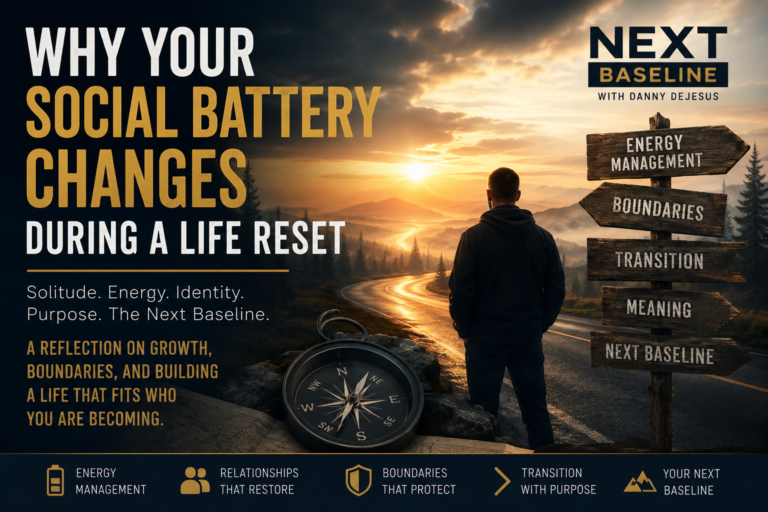
The first sign of a life reset rarely arrives as a dramatic collapse. More often, it shows up quietly as a shift in what you can tolerate and what you refuse to keep feeding with your time. In this Next Baseline conversation, Danny DeJesus names a common but misunderstood signal of personal growth: you stop wanting to give energy to the same people, places, and conversations that once felt normal.
That change can look like pulling back from constant socializing, craving low-stimulus space, or choosing a smaller circle that feels meaningful instead of performative. For many people, that is not isolation. It is energy management, a mental health boundary, and an early sign of a deeper life transition.
Danny ties that shift to lived experience: anxiety in crowded rooms, the drain of small talk, and the emotional cost of carrying other people’s self-made chaos. When you have been through divorce, financial stress, professional pressure, custody battles, and repeated responsibility, your nervous system starts telling the truth about what is sustainable. You can call it burnout, overload, or simply a new season, but the result is often the same: old demands stop fitting.
Instead of asking, “What’s wrong with me?” a healthier question begins to appear: “Where do I want my energy to go?” That reframing turns shame into clarity and replaces people-pleasing with intentional boundaries.
A major theme in this episode is career change and identity change, especially through the lens of long military service. Danny shares joining the Air Force in 2005, later transitioning into the Space Force, and spending more than two decades in uniform. He holds pride and gratitude for that work while also being honest about what service requires: time, focus, family sacrifice, physical and emotional bandwidth, and the pressure to keep showing up.
Over time, he notices he no longer hungers for that pace the way he once did. Not from bitterness, but from fatigue, growth, and evolution. This is a powerful model for anyone navigating a professional transition: you can honor what a chapter gave you and still decide it is time to re-vector your purpose.
From there, the conversation moves into meaning and alignment. Danny points toward coaching and frameworks like C2R2E, which stands for Collapse, Confrontation, Realignment, Reclamation, and Elevation, as tools for making sense of change. The goal is not to disappear from life. The goal is to build a life where your energy is placed with deliberate intention.
Solitude and introspection become practical skills, not abstract ideas. Silence reveals what constant stimulation hides. It shows what drains you, what restores you, and where you may still be operating from duty, guilt, fear, or an outdated identity.
The closing reflection questions act like a compass for your next baseline: what chapter is already complete, where are you staying connected out of habit, and what does your next season need to look like so it feels aligned with who you are becoming?
🔄Did you find this article helpful? Share it!

About the Author - Danny DeJesus
Danny De Jesus is a transformational resilience thought leader, strategic thinker, and the founder of Elevatus Coaching—a practice built to help people rebuild their lives after major change. Drawing from his own experiences with divorce, co-parenting, and career shifts, he created the C2R2E Framework to guide people from collapse to elevation with clarity and confidence. Through the Elevatus Blog, he shares insights for anyone navigating disruption, rebuilding direction, or shaping a new chapter with purpose.