
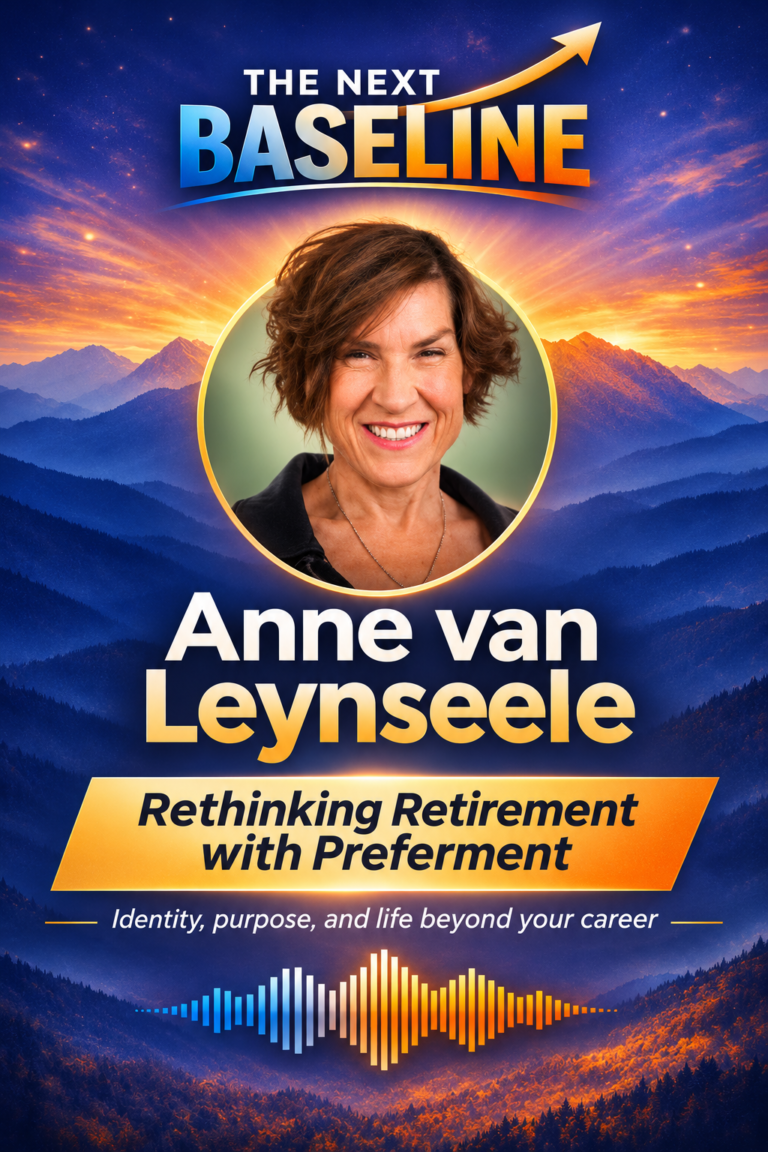
“I am a multiplicity. I am a person with many layers.”
Anne van Leynseele
Featured Guest: Anne van Leynseele
For generations, retirement has been presented as the ultimate reward for a lifetime of hard work. We spend decades building careers, developing our skills, raising families, and preparing financially for the day we can finally step away. The promise is familiar: work hard enough, save enough, and eventually enjoy the freedom to spend your time however you choose.
But there is something missing from that promise. What happens when the career ends, but our desire to grow, contribute, and accomplish meaningful things remains? What happens when we wake up on that first ordinary Monday and realize that the people, responsibilities, and routines that once organized our lives are no longer waiting for us?
For many people, retirement is more than a financial milestone. It represents a significant change in identity. The professional title that once introduced us to the world begins to lose its relevance. The structure that shaped our days disappears, and the relationships built through years of working together may become more distant. Even when retirement is something we have spent years looking forward to, the reality can bring unexpected feelings of uncertainty, loss, and disconnection.
These questions were at the center of my conversation with Anne van Leynseele, an attorney, entrepreneur, and author who has spent more than three decades navigating change across industries ranging from entertainment and technology to healthcare, law, and agriculture. Anne has developed a different way of thinking about retirement, one that challenges the idea that our later years should be defined primarily by rest and withdrawal from professional life.
Her alternative is something she calls Preferment, a philosophy that asks us to stop treating retirement as the end of our productive lives and begin seeing it as an opportunity for advancement, growth, and personal reinvention.
Retirement Was Designed for a Different World
Anne’s interest in redefining retirement began during her four years as an attorney adviser with the Social Security Administration. Through that experience, she became increasingly concerned about the difference between how people prepared financially for retirement and how they prepared for the lives they would actually lead afterward.
During our conversation, Anne reflected on the origins of Social Security in 1935 and the economic conditions that shaped traditional retirement expectations. At the time, many workers spent their careers performing physically demanding labor in agriculture, manufacturing, and other industries. Retirement was commonly understood as a period of rest following decades of difficult work. Yet the world has changed considerably, and the length and nature of retirement have changed with it.
Today, many people spend their careers in professional, technical, administrative, and service-based occupations. Advances in healthcare and longer life expectancy also mean that retirement can last 20 or 30 years, sometimes longer. Anne questions whether a model centered on permanent rest can provide the fulfillment people need throughout such an extended period of life.
She jokingly described the conventional retirement lifestyle as one filled with “Netflix, naps, and pickleball.” There is certainly nothing wrong with relaxing, traveling, enjoying hobbies, or spending time with loved ones. Those activities can bring considerable happiness. The concern arises when relaxation becomes the entire plan and individuals begin to lose the daily challenges, social connections, and sense of purpose that once supported their well-being.
Anne also raised concerns about loneliness, depression, and social isolation among retirees. These are important issues because leaving a career can mean losing much more than a paycheck. It can also mean losing a community, a familiar routine, and regular opportunities to contribute. While retirement affects everyone differently, the conversation highlighted the importance of preparing for the social and emotional changes that often accompany it.
Financial planning remains essential, but a retirement account cannot determine what makes a person feel fulfilled. Someone can have sufficient savings, a comfortable home, and complete freedom over their schedule while still struggling to answer a fundamental question: What am I going to do with the rest of my life?
That is the question Anne believes deserves far more attention.
Preferment: A Different Way to Think About Retirement
The word preferment dates back to the 15th century and refers to advancement or promotion. Anne adopted the term because she believes the years following a primary career should represent an opportunity to move toward something meaningful rather than simply withdraw from what came before.
Her 2026 book, Preferment, introduces a guided process for helping individuals prepare for that next stage of life. Rather than beginning with activities to fill the calendar, Anne encourages people to examine their identity, personal values, relationships, and ambitions. The goal is to create a lifestyle that reflects who they want to become, not merely one that replaces the time they previously spent working.
One concept that stood out during our conversation was what Anne calls “excavating the want.” It describes the process of looking beneath years of obligations, expectations, and established routines to rediscover what we genuinely desire from life. This can be surprisingly difficult, particularly for individuals who have spent much of their adult lives placing professional and family responsibilities ahead of their personal interests.
Think about how often our decisions are shaped by what needs to be done. We accept assignments, pursue promotions, relocate for opportunities, meet deadlines, and arrange our schedules around the needs of others. Many of those decisions are necessary, and they can produce meaningful accomplishments. But somewhere along the way, we may stop asking whether the direction we are moving still reflects the life we want.
Anne’s approach encourages people to begin those conversations before retirement. Through exercises that explore personal roles, values, interests, and aspirations, individuals can develop a clearer sense of what they want their next chapter to represent. Her program emphasizes manageable steps rather than expecting someone to reinvent an entire life overnight.
Preferment does not suggest that everyone must continue working, start a business, or pursue another major professional achievement. Instead, it invites people to consider what a fulfilling life might look like when they have greater freedom to make decisions on their own terms.
When a Career Becomes Part of Who We Are
This conversation carried particular meaning for me because I am preparing for my own retirement from the United States Space Force after what will be 22 years of active-duty military service. The decision to retire came after considerable reflection about my professional accomplishments, personal priorities, and the direction I want my life to take.
Interestingly, I was recently selected for promotion to Senior Master Sergeant. That recognition means a great deal because it represents years of dedication, professional growth, and contributions to the military. Yet even with that accomplishment, my decision to retire remains unchanged. I have reached a point where I recognize that there are other parts of my life I want to develop, and continuing to serve in uniform is no longer the direction I want to pursue.
For military veterans, this transition can be particularly complicated. Military service provides more than employment. It creates a way of life built around structure, responsibility, shared experiences, and a strong sense of belonging. Over time, that environment becomes deeply connected to how we understand ourselves. When we leave, we are not simply changing employers. We may also be leaving behind an identity that has shaped nearly every major decision of our adult lives.
The same experience can affect executives, educators, healthcare professionals, entrepreneurs, and others who have devoted decades to their careers. When someone has spent 20, 30, or 40 years becoming exceptionally good at something, it can be difficult to imagine a future where that accomplishment is no longer central to everyday life.
Anne explained that retirement, layoffs, and career changes can produce different circumstances, but they often share the challenge of redefining personal identity. Even when leaving is a voluntary decision, people may experience a sense of grief over the roles, relationships, and responsibilities they are leaving behind.
This is where I see a clear connection between Preferment and the C2R2E framework I developed through Elevatus. Life transitions frequently require us to confront the difference between who we have been and who we want to become. Before we can establish a new direction, we often need to acknowledge what has changed, understand what we are leaving behind, and decide what deserves to move forward with us.
The challenge is not forgetting our careers or minimizing their importance. It is learning to appreciate those experiences without allowing them to determine everything about our future.
Rediscovering Identity Through the Many Hats We Wear
One of Anne’s most practical approaches to identity development is an exercise she calls Hats. The idea is simple: write down the different roles you have held throughout your life, including those that have little or nothing to do with your professional career.
Anne explained that she once identified approximately 200 different roles across her personal and professional experiences. These included formal responsibilities, family relationships, and the informal roles we often take on without recognizing them. A person might be a parent, sibling, friend, mentor, volunteer, teacher, organizer, caregiver, or problem-solver. Within a workplace, they might also be the individual who keeps a team focused, brings people together, or helps others navigate difficult situations.
The importance of this exercise lies in recognizing that we have never been defined by a single role, even when one role has occupied most of our time and attention. Our identities are made up of many experiences, relationships, abilities, and personal characteristics. Some have been highly visible throughout our careers, while others may have received very little attention.
Anne encourages individuals to examine those roles and identify the parts of themselves they most enjoyed. When did they feel confident, fulfilled, or balanced? Which experiences brought out their strongest qualities? What personal values were present during those moments?
These questions can reveal possibilities that might otherwise remain hidden. Someone who spent decades in management may discover that mentoring was the most rewarding part of the job. A technical professional may realize that their greatest satisfaction came from teaching others or solving unfamiliar problems. A person who spent years organizing family activities may discover a genuine interest in community development or event planning.
The purpose is not to recreate the past. It is to identify the qualities and experiences that can help shape the future. When people understand that they have always been more than their professional titles, they can begin approaching retirement with a wider sense of what is possible.
Finding Purpose Through Curiosity and Exploration
Another meaningful part of our discussion involved the pressure people place on themselves to discover their next purpose. When approaching retirement or another major life transition, it is easy to believe that we need a complete plan before moving forward. We want to know exactly what comes next, how we will spend our time, and whether our decisions will lead to fulfillment.
Anne shared a story about a woman working in the technology industry who struggled to define her future direction. During their work together, the woman initially approached the exercises by writing down what she believed her answers should be. Despite her efforts, she had difficulty identifying something that genuinely excited her.
Then Anne asked about her weekend. The woman began describing a recent hike through a national forest, and her enthusiasm immediately became apparent. Rather than continuing to search for the perfect personal mission statement, Anne suggested that she explore the forest as a central theme for her next chapter.
Within hours, the woman developed a lengthy list of possible activities and organizations connected to that interest. Her ideas ranged from conservation work to helping young people learn outdoor navigation skills. What had initially seemed like an overwhelming search for purpose began taking shape around something she already enjoyed.
This story illustrates an important point about personal growth. We do not always discover our direction through intense reflection alone. Sometimes we learn more about ourselves by trying something unfamiliar, reconnecting with an old interest, or simply paying attention to experiences that bring us genuine enjoyment.
Anne applied that principle to her own life by spending several months exploring introductory classes in activities ranging from dancing and martial arts to meditation. Through that experiment, she discovered a fitness program that became part of her regular routine. It was not something she had originally planned to pursue, but giving herself permission to explore created an opportunity she might never have considered otherwise.
For people navigating life transitions, there is value in approaching the future with curiosity rather than demanding immediate certainty. A new direction does not always announce itself through a life-changing revelation. Sometimes it develops through small experiences that gradually help us understand what we want.
Personal Agency and the Freedom to Choose Differently
As our conversation continued, we explored the importance of personal agency. Anne considers agency one of the most important parts of building a fulfilling life because it requires individuals to take responsibility for the decisions that shape their future.
She shared the story of her mother, who was 86 at the time of our conversation. After losing her husband of 60 years, Anne’s mother faced a major transition. Much of her adult life had been shaped by marriage, family, and the responsibilities that came with those relationships. Following her husband’s death, she had to develop a new understanding of what it meant to live independently.
Anne encouraged her mother to recognize that she was entering a different chapter of life and that she had the ability to shape it. Although the loss of a spouse creates circumstances that no one would willingly choose, the experience also illustrated the importance of maintaining a sense of independence, curiosity, and personal direction.
This idea extends well beyond retirement. Life transitions can arrive through divorce, career loss, military separation, changes in family responsibilities, or circumstances completely outside our control. We may not have chosen the event that changed our lives, but we can gradually reclaim the ability to decide how we respond and what we build afterward.
During our conversation, Anne asked a question that captured the challenge of moving beyond an established identity: “What are you now? Who are you now?”
It is an important distinction because many people continue introducing themselves through the careers they once held. They describe what they used to do, the organizations they worked for, and the positions they occupied. Those experiences are worth honoring, but they do not necessarily explain who the person is today.
Personal agency requires us to recognize that our previous accomplishments can remain part of our story without becoming the limits of our future. We can carry forward our experience, wisdom, and values while still allowing ourselves to develop new interests, relationships, and aspirations.
Movement, Learning, and the Need to Belong
Anne also described three elements that she believes contribute to a fulfilling life after retirement: physical movement, intellectual challenge, and meaningful social connection.
The first involves maintaining an active lifestyle. Anne emphasized that movement does not necessarily mean formal exercise. It can involve gardening, walking, working around the home, participating in community activities, or pursuing interests that encourage people to remain physically engaged. The specific activities will naturally vary according to a person’s abilities, health, and circumstances, but the broader principle is to remain involved in daily life rather than allowing inactivity to become the default.
The second element is intellectual challenge. Anne believes learning should continue throughout life, but she also encourages people to do something with the knowledge they gain. That might involve developing a new skill, teaching others, studying an unfamiliar subject, or pursuing a project that requires sustained attention. The purpose is to keep curiosity alive and maintain opportunities for growth long after formal professional development comes to an end.
The third element is belonging. Anne spoke about the importance of maintaining emotionally meaningful relationships, particularly those that connect people across generations. These relationships provide opportunities to exchange experiences, learn from different perspectives, and remain connected to a broader community.
Together, these elements highlight something that is easily overlooked in retirement planning. A meaningful life requires more than having activities available. It also involves having reasons to participate, opportunities to develop, and people with whom we can share our experiences.
At the same time, fulfillment should not become another measure of constant productivity. Retirement does not need to become a second career filled with endless obligations and expectations. The goal is to develop a lifestyle that provides enough challenge, connection, and personal satisfaction to make each stage of life meaningful.
Contribution Does Not Have to End With Employment
Anne’s own experiences demonstrate how personal contribution can take different forms throughout life. At 48, she purchased a neglected farm on Hawaii’s Big Island with her mother and began restoring the property. The project introduced her to an unfamiliar environment and responsibilities that were very different from her professional work as an attorney.
She also contributes her legal expertise to five nonprofit organizations. Through those commitments, she continues using skills developed during her career while supporting causes that matter to her personally. Her activities demonstrate that retirement does not necessarily require people to abandon their professional experience. Instead, it can create opportunities to apply that experience in ways that better reflect their values.
One of Anne’s central messages is that people do not need extraordinary financial resources to find meaning in their later years. There are opportunities to contribute through volunteering, mentoring, community involvement, personal projects, education, and relationships. Some may require significant resources, while others begin with nothing more than time, interest, and a willingness to participate.
This is especially important for people who struggle with the belief that their usefulness depends on receiving a paycheck or holding a professional position. Employment can provide a valuable structure for contribution, but it is not the only way we create value in our lives or the lives of others.
The challenge is learning to distinguish between what we were professionally responsible for and what we genuinely want to contribute going forward. Sometimes those things will overlap, and sometimes they will lead us in entirely different directions. Both possibilities deserve consideration.
Where Preferment and C2R2E Meet
Throughout our conversation, I found several connections between Anne’s approach to retirement and the broader process of life transition management.
C2R2E recognizes that major life changes frequently involve five interconnected stages: Collapse, Confrontation, Realignment, Reclamation, and Elevation. These stages help us understand the process of moving from a life that has changed toward one that reflects our evolving identity, priorities, and goals.
Retirement offers a particularly useful example of how these stages can unfold. The end of a career can create a disruption in someone’s sense of identity, even when leaving is a deliberate choice. That disruption may require confronting difficult questions about personal worth, purpose, and belonging before an individual can begin establishing a new direction.
Realignment involves examining what matters now and determining how our future decisions should reflect those priorities. Reclamation is the process of reconnecting with parts of ourselves that may have been overlooked or set aside. Elevation comes as we begin applying those insights to create a life that is more intentional and fulfilling.
Preferment provides a practical approach to several of these challenges by encouraging individuals to examine their identities, explore their interests, and create a personal vision for life beyond their careers.
The frameworks are not identical, nor do they need to be. Preferment focuses on reimagining retirement and the years that follow a primary career, while C2R2E addresses a broader range of life transitions, including those that are unexpected, painful, or outside our control.
What connects them is the recognition that meaningful change requires more than leaving one situation and entering another. We also have to understand what that change means for who we are and how we want to live.
The Next Baseline: Building a Life Beyond the Career
As our conversation came to a close, Anne shared a lesson her parents taught her about leaving the world a better place than she found it. She believes everyone has the capacity to make a difference, whether through large accomplishments or smaller everyday contributions.
That perspective stayed with me because it captures something important about the transition I am approaching in my own life. My military career has been a significant chapter, filled with challenges, accomplishments, relationships, and experiences that will always remain part of who I am. Yet I also recognize that the end of that chapter creates an opportunity to invest more intentionally in other areas of my life.
There are still people I want to serve, ideas I want to develop, places I want to experience, and goals I want to pursue. Some of those ambitions will build directly on the skills and knowledge I gained during my military service. Others will take me into unfamiliar territory, where I will once again have to learn, adapt, and grow.
And perhaps that is one of the most valuable lessons from our conversation. Retirement does not have to represent a final destination. It can become a period of rediscovery, where individuals begin making decisions based not only on what they have accomplished but also on what they still want to experience.
That does not mean the transition will always be easy. Leaving behind a familiar identity can involve uncertainty, grief, and difficult decisions. There may be moments when the security of the past feels more comfortable than the possibilities of the future. Those feelings are part of the process, and acknowledging them does not diminish the opportunities that may lie ahead.
What matters is recognizing that we are not required to remain the same people simply because we have spent decades becoming who we are today.
Anne’s philosophy offers one way to approach that realization. Preferment encourages us to move beyond the idea of retirement as withdrawal and consider how we might continue growing, contributing, and building meaningful relationships throughout our lives.
For me, that is ultimately what reaching the next baseline represents. It is not about abandoning the past or pretending that everything ahead will be better. It is about taking what we have learned, understanding what matters to us now, and choosing how we want to move forward.
So, as you think about your own career, relationships, responsibilities, and future, consider the question I shared at the end of our conversation.
If your career ended tomorrow, what part of your identity would remain, and what would you want to build next?
The answer may not come immediately. It may require reflection, experimentation, and a willingness to reconsider assumptions you’ve carried for years. But the process of discovering that answer is an opportunity to shape a future that reflects the person you are becoming.
Your career may eventually end. Your title may change. The responsibilities that once defined your everyday life may no longer exist.
But your story does not have to end with them.
The next baseline is still yours to build.
Listen to the Full Conversation
This Elevatus Editorial accompanies a conversation with Anne van Leynseele, author of Preferment and founder of Rarified Life, on The Next Baseline with Danny DeJesus. Together, they explore professional identity, personal agency, the challenges of retirement, and what it means to build a meaningful life beyond our careers.
 Listen to the full episode below.
Connect with Anne
Anne van Leynseele is an attorney, entrepreneur, author, and founder of Rarified Life. Her 2026 book, Preferment, offers a modern alternative to traditional retirement by helping individuals explore their identities, clarify personal values, and develop meaningful goals for life beyond their primary careers.
Readers can learn more about Anne’s philosophy, her Preferment workbook, and her programs by visiting Rarified Life. Her book, Preferment, is also available through booksellers, and she can be found professionally on LinkedIn.
Anne also discussed her free resource, 30 Days to Joy, which introduces small, practical activities designed to encourage greater connection with people, nature, and local communities. Additional information about her resources and offerings can be found through her website.
🔄Did you find this article helpful? Share it!

About the Author - Danny DeJesus
Danny De Jesus is a transformational resilience thought leader, strategic thinker, and the founder of Elevatus Coaching—a practice built to help people rebuild their lives after major change. Drawing from his own experiences with divorce, co-parenting, and career shifts, he created the C2R2E Framework to guide people from collapse to elevation with clarity and confidence. Through the Elevatus Blog, he shares insights for anyone navigating disruption, rebuilding direction, or shaping a new chapter with purpose.