“Transition from the military is not simply about finding another job. It is about deciding what kind of life you want to build next.”
Danny DeJesus
There comes a point in every military career when the uniform eventually comes off.
For some, that moment comes after four years. For others, it comes after eight, twelve, twenty, or more. Some service members know early that the military will be only one chapter in their lives. Others build nearly an entire adult identity around service before finally arriving at the question that every military career eventually forces: what comes next?
For me, that question is no longer abstract.
After more than twenty years of service, first in the United States Air Force and later in the United States Space Force, I made the decision to retire. The decision itself did not happen the day I submitted paperwork. In many ways, it began about a year earlier, when I finally had to admit something to myself that I had resisted for some time.
And that was: “I did not have much left in the tank to give.”
That realization was not rooted in anger or regret. I am proud of my service and grateful for many of the opportunities, relationships, challenges, and lessons that came with it. But there is a point when perseverance has to meet self-awareness. My mind, body, and spirit had all started telling me the same thing: this chapter was reaching its end.
Military culture teaches us to push through. We complete the mission. We take care of the people around us. We find a way. There is value in that mentality, and it has carried me through some difficult seasons. But I have also come to believe that knowing when to continue and knowing when to change direction are both forms of strength.
Eventually, I had to give myself permission to say, I gave this chapter what I had to give.
And once I accepted that, the transition became about far more than retirement paperwork.
It became about identity.
It became about health.
It became about career, money, education, purpose, family, and the kind of life I actually want to build after military service.
That is why this conversation belongs so naturally within The Next Baseline. The question at the center of the C2R2E framework has always been:
What do we build now to reach our next baseline?
Military retirement has simply made that question deeply personal.
When the Decision Becomes Real
One of the first things I have learned is that transition should begin much earlier than most people think. If someone asked me today when they should begin preparing to leave the military, I would recommend roughly two years before separation or retirement. Twenty-four months may sound excessive until you realize how much there is to learn.
Transitioning service members have to understand civilian hiring, resumes, LinkedIn, networking, informational interviews, compensation, benefits, interviews, SkillBridge, education, certifications, VA processes, medical documentation, and how to explain a military career to people who may have no idea what any of our titles or acronyms mean. Somewhere in the middle of all of that, we also have to figure out what we actually want.
That is no small task.
I sometimes think of military transition as an education in itself. You have to study it. You have to practice it. You have to ask questions, make mistakes, adjust, and learn from people who have already gone through it. The earlier that process begins, the more room there is to explore rather than panic.
Take Care of Yourself Before You Leave
Health has become another major part of my transition. I have spent months navigating medical appointments, referrals, treatment, documentation, and my own health challenges. That experience has reinforced something I now feel strongly about: if something is wrong, get seen.
Do not put it off because the mission is busy. Do not convince yourself that you can deal with it later. And do not allow a culture of toughness to make you believe that seeking care somehow makes you less committed.
The mission matters. It always will. But the people carrying out that mission matter too.
I believe leaders at every level have a responsibility to create an environment where service members can get the medical care they need without being treated as weak or inconvenient. There is a difference between resilience and neglect, and too often those two ideas have been confused.
There is also a practical reality to this. If a medical issue is never evaluated, never documented, and never entered into a record, it may become far more difficult later to establish that it occurred during military service. That does not mean exaggerating symptoms or chasing diagnoses. It means being honest about what is happening and taking care of yourself while you still can.
The military will continue after we leave. Our families, our bodies, and our lives still have to carry what remains.
Your Specialty Is Not Your Ceiling
Another lesson has been learning to separate my military specialty from my professional identity.
For more than twenty years, I developed specialized experience inside military organizations. It would be easy to look at that experience and assume that the next logical step is simply to find the civilian equivalent of what I have already done.
But I do not believe that is the only path available to me.
The military taught me more than a specialty. It taught me how to think strategically, analyze complex problems, advise senior leaders, navigate organizational change, communicate complicated information, develop people, operate in uncertainty, and turn large amounts of information into something useful for decision-makers.
Those are not simply “soft skills.” They are transferable professional capabilities.
That distinction matters because transitioning veterans can easily underestimate themselves by focusing too narrowly on job titles. An AFSC, MOS, rating, rank, or duty title may describe where someone worked, but it does not necessarily describe everything that person learned how to do.
A more useful question is not only, “What civilian job matches my military job?”
It is, “What did all those years teach me how to do?”
That question opens a much wider field of possibility.
Translate the Value, Not Just the Title
Of course, recognizing your capabilities is only part of the challenge. You also have to learn how to explain them.
Military language is its own language. We use acronyms, organizational structures, titles, and performance terminology that make perfect sense inside the military and can mean absolutely nothing to a civilian employer. Transition requires learning how to translate value.
What did you lead? What problems did you solve? What changed because you were there? What decisions did your work support? What resources did you manage? What processes improved? What outcomes did you influence?
Your military title may not translate.
But your impact can.
Build the Network Before You Need It
Networking has become another lesson I wish more service members understood earlier.
Networking is not asking strangers for jobs. It is relationship-building. It is curiosity. It is talking to people who work in industries or organizations you are considering and asking intelligent questions. How did you get there? What skills does your organization value? What mistakes do transitioning veterans make? What should someone with my background learn?
Those conversations matter.
Informational interviews matter.
LinkedIn matters.
Staying in touch matters.
And the worst time to begin building a network is when you urgently need something from everyone in it.
Build relationships early.
Stay curious.
Be useful where you can.
Stay connected.
Sometimes opportunities come through relationships long before they ever come through an application portal.
The Village Behind the Transition
I have been fortunate to have a strong village around me during this transition. TAP, FourBlock, Hiring Our Heroes, Hire Heroes USA, Wounded Warrior Project, and others have all played a role in helping me understand different parts of the process. I am not endorsing one organization over another. I am simply acknowledging what they have meant in my own experience.
FourBlock helped me better understand the civilian employment landscape, how military experience translates, and how to approach professional relationships and employers. Hiring Our Heroes added another layer of exposure and opportunity. Hire Heroes USA provided resources around professional preparation. Wounded Warrior Project offered support and resources during a challenging period. My TAP experience was foundational, and I remain grateful for the representatives and instructors who genuinely cared about my transition.
People matter in this process.
Someone explains something you did not know.
Someone reviews a resume.
Someone introduces you to another person.
Someone tells you what they wish they had understood sooner.
Someone opens a door.
No one transitions as independently as they sometimes imagine they do.
That village is part of why I feel a responsibility to pass the knowledge forward.
Learn the Tools Shaping the Next Workforce
The workforce itself is also changing, which means transitioning veterans need to understand artificial intelligence (AI). I do not mean that everyone suddenly needs to become an engineer. I mean that AI is rapidly becoming part of how people research, write, analyze, communicate, prepare, learn, and make decisions.
Ignoring that would be a mistake.
The value is not in AI alone. The value is in the combination of AI with judgment, experience, critical thinking, and professional expertise. A veteran with twenty years of experience who understands how to use AI responsibly may be able to amplify capabilities that already exist.
That means learning both the opportunities and the limitations. AI can be wrong. It can hallucinate. It raises information-security concerns. Sensitive, classified, proprietary, or protected information does not belong in public systems. The technology has to be used with discipline.
Education Can Expand the Map
Education is another area where I carry a clear bias.
I believe in it.
Not because everyone needs a master’s degree, and not because people should collect credentials for the sake of appearances. But education can open doors we do not always know exist when we begin.
My master’s degree is in Education, specifically Higher Education Administration with a coaching concentration. I may never spend my civilian career working in a traditional university setting. That does not mean the degree was wasted.
The program helped me understand people, learning, coaching, leadership, communication, organizations, systems, and change. It expanded the way I think, and I have already found ways to apply those lessons far outside the title of the degree itself.
Sometimes education does more than qualify you for a job.
Sometimes it expands the number of problems you know how to understand.
For service members who have access to tuition assistance, credentialing programs, GI Bill benefits, or other educational opportunities, I think it is worth exploring what those resources could create. The answer may be a degree. It may be a certification. It may be a trade, an apprenticeship, or something else entirely.
The point is not to accumulate credentials.
The point is to expand options.
Know Your Number Before the Offer Comes
Compensation is another area where preparation matters.
Veterans should not wait until an employer asks about salary expectations before thinking about what they are worth in the market. Study comparable roles. Look at geography, industry, experience, education, credentials, company size, and specialized qualifications. Talk to separated and retired colleagues. If they are comfortable sharing, ask what compensation range they are seeing for people with similar backgrounds.
Go into negotiation with a number in mind.
Know your target.
Know your reasonable range.
Know your floor.
But make sure those numbers are grounded in reality.
Military rank does not automatically translate into civilian salary, and the salary attached to a role does not define your worth as a professional or a person.
Different markets value different things. Someone may command one level of compensation inside the defense industry because of specialized experience, clearance eligibility, or domain knowledge. Outside of that environment, the market may price those capabilities differently.
That does not automatically make an opportunity worse.
It simply means that veterans have to decide what matters most.
Salary matters. So do flexibility, location, family time, travel, growth, health, purpose, remote work, benefits, and the kind of life someone is trying to create.
The highest-paying opportunity is not always the best opportunity.
You Are Allowed to Choose a Different Industry
That lesson connects directly to another realization I have had: veterans do not have to remain in defense.
There are excellent opportunities there, and for many people it will be the right choice. Their experience may translate directly. Compensation may be strong. A clearance may remain valuable. The mission may still feel meaningful.
But staying in defense is not the only successful transition.
Veterans are allowed to become something different.
Corporate America. Higher education. Technology. Consulting. Government. Nonprofit work. Entrepreneurship. Coaching. Something entirely unexpected.
There may be tradeoffs. There may be a different title or a different salary. There may be a learning curve.
That does not mean someone is starting over.
They are starting again, with experience.
Employers Are Part of the Transition Too
Employers also have a role to play in this transition.
There is an enormous amount of talent leaving military service every year. Strategic thinkers, technical professionals, leaders, program managers, communicators, analysts, operators, logisticians, and problem-solvers enter the civilian workforce with years of experience operating under pressure and navigating complexity.
Some of that talent is still being overlooked because employers do not always understand how to interpret military experience.
Veterans absolutely have a responsibility to learn civilian language. But employers can also meet them halfway.
I would like to see more organizations build real veteran recruiting expertise into their staffing structures. Not simply someone who attends a career fair once a year, but someone who understands military careers, leadership structures, and how to look past unfamiliar terminology to recognize capability.
Being veteran-friendly should mean more than putting a statement on a careers page.
It should mean knowing how to recognize veteran talent when it is standing in front of you.
When the Uniform Is No Longer the Identity
Ultimately, though, this transition keeps bringing me back to identity.
For more than twenty years, military service has provided structure around much of my life. Air Force. Space Force. Rank. Mission. Leadership. Responsibility. Organization.
Eventually, those structures begin to disappear.
Someone else fills the role.
Someone else takes the mission.
The meetings continue.
The emails continue.
The organization moves forward.
And the person leaving has to answer a different question.
Who am I now?
And I am still answering that.
I am a father. A professional. A coach. A writer. A podcaster. A strategist. Someone interested in leadership, people, communication, change, growth, and helping others figure out what comes next.
I am learning how those pieces fit together when military service is no longer the center of my professional identity.
The C2R2E Lens
That is why I see this transition so clearly through the lens of C2R2E.
The familiar baseline changes.
We confront what is no longer working.
We realign around what matters now.
We reclaim parts of ourselves that may have been buried inside a role or institution.
And then we begin to elevate into whatever comes next.
Military transition is not simply a job search.
It is the rebuilding of a baseline.
Passing It Forward
I am able to navigate this season because people have helped me. Veterans shared lessons. Mentors answered calls. Recruiters explained things I did not know. TAP instructors taught. FourBlock created perspective and connection. Hiring Our Heroes opened opportunities. Hire Heroes USA provided resources. Wounded Warrior Project offered support. Colleagues shared lessons, salary insight, mistakes, and experience.
People passed knowledge to me.
Now I feel responsible for passing some of it forward.
If one service member reads this and starts preparing earlier, schedules the medical appointment they have been avoiding, begins building a network, discovers FourBlock or another transition program, researches their market value, learns how to use AI, considers education, or simply realizes that they are allowed to imagine a completely different life after military service, then this conversation has value.
I made the decision to retire.
I know this chapter is ending.
I am proud of the person I was in uniform, and I am curious about the person I will become without it.
Those two truths do not compete with one another.
I do not have to reject the chapter I am leaving to be excited about the one I am entering.
And maybe that is what transition really asks of us.
Not to have the next twenty years completely figured out.
Not to erase where we have been.
But to recognize when an old baseline is changing, decide what still matters, and begin building again.
Because eventually the uniform comes off.
And when it does, the question remains:
What do we build now to reach our next baseline?
Listen to the Full Conversation
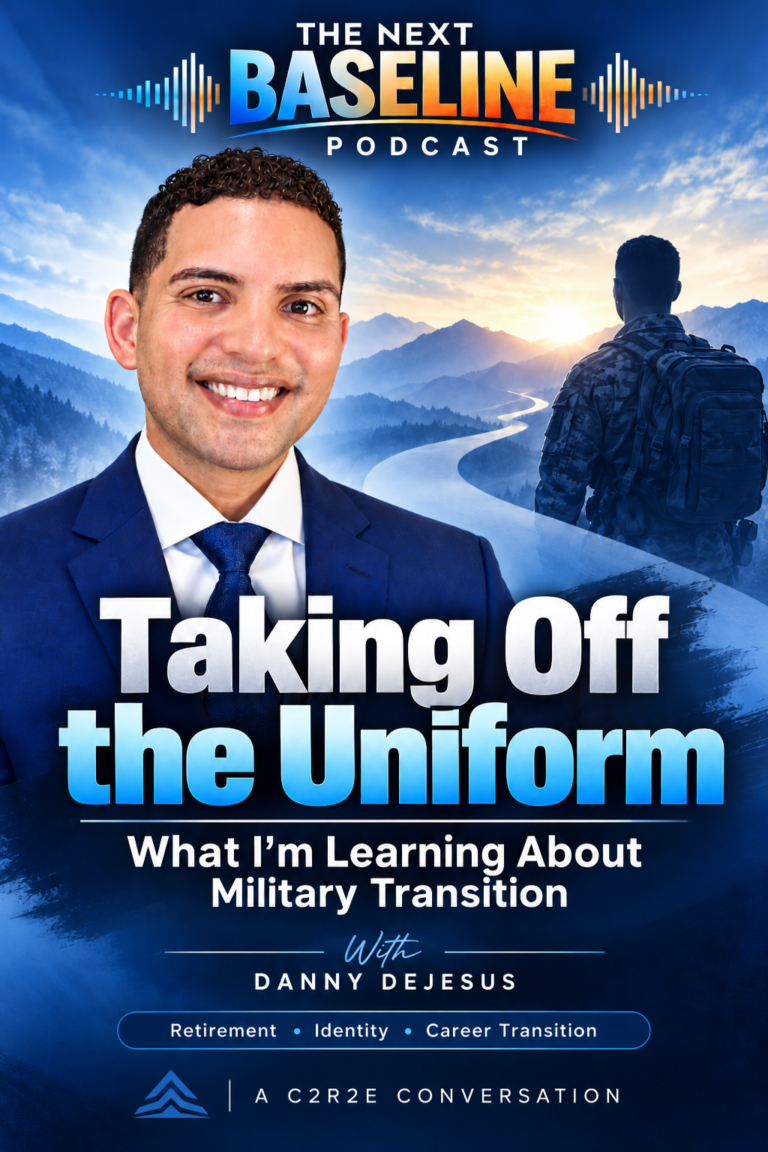
This Elevatus Editorial accompanies a special solo episode of The Next Baseline, where Danny DeJesus reflects on his own transition from more than two decades of military service and the lessons he is learning along the way. Through the lens of C2R2E, the conversation explores what it means to honor the chapter we are leaving while intentionally building the one that comes next.
 Listen to the full episode below.
🔄Did you find this article helpful? Share it!

About the Author - Danny DeJesus
Danny De Jesus is a transformational resilience thought leader, strategic thinker, and the founder of Elevatus Coaching—a practice built to help people rebuild their lives after major change. Drawing from his own experiences with divorce, co-parenting, and career shifts, he created the C2R2E Framework to guide people from collapse to elevation with clarity and confidence. Through the Elevatus Blog, he shares insights for anyone navigating disruption, rebuilding direction, or shaping a new chapter with purpose.