
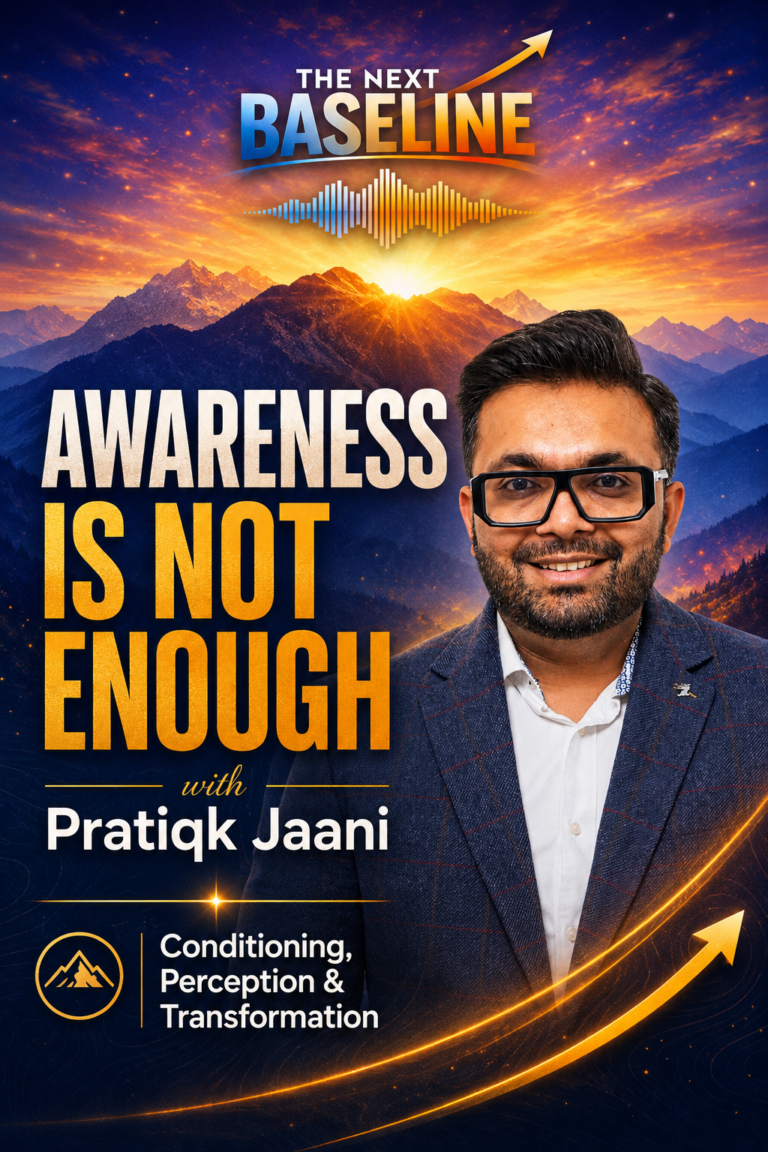
“If everything that I believed I was was learned, that means it isn’t me. Then who am I?”
Pratiqk Jaani
Featured Guest: Pratiqk Jaani
There is a frustrating point in personal growth when we can clearly see a pattern and still find ourselves repeating it. We understand why certain situations make us defensive. We recognize the relationships we keep recreating, the fears that influence our decisions, or the ways we respond when life becomes uncertain. We may even be able to trace some of those behaviors back to where they began.
And yet, understanding does not always stop the pattern.
That tension became the center of my recent conversation with Pratiqk Jaani on The Next Baseline. Pratiqk is a business adviser, qualified hypnotherapist, author, and creator of the Dhrasti Method, an approach centered on perception, conditioning, and the distinction he makes between the conditioned identity and what he describes as the deeper self.
Our conversation moved through entrepreneurship, illness, identity, spirituality, fear, hypnotherapy, perception, and personal transformation. But underneath all of it was a question that extends far beyond any one methodology: Why can we become aware of what is shaping us and still struggle to change it?
That question matters because life transitions rarely give us a completely blank slate. We may leave the job, relationship, environment, belief system, or version of life that no longer fits us, but we do not automatically leave behind everything we learned while living there.
Sometimes the old life follows us into the new one.
When Disruption Creates Space to See
Pratiqk’s own transition began with a significant disruption. In 2017, he was diagnosed with tuberculosis in his spine and spent approximately three months largely confined to bed. Before that diagnosis, he had spent years considering leaving accounting and starting his own business, but the risks were difficult to ignore. He was the primary breadwinner, had a comfortable income, and was surrounded by people who understandably questioned why he would exchange stability for uncertainty.
Then illness interrupted the routine.
During that period, Pratiqk began considering what would happen if his life ended before he ever pursued the things he kept telling himself he wanted to do. His conclusion was uncomfortable but clarifying: life would continue. People would grieve, circumstances would change, and eventually those around him would find ways to move forward.
The question then became less about death and more about life. Did something catastrophic have to happen before he gave himself permission to live differently?
What followed was not an impulsive leap into uncertainty. Pratiqk eventually moved into consulting, began developing clients alongside his employment, reduced his expenses, and left his job once his business had reached a level that made the transition more manageable. The external transition mattered, but what interested me more was the internal shift that made the external transition possible.
For months, much of the noise of everyday life had disappeared. He had time to think, observe, question, and reconsider assumptions that had previously existed largely unchallenged.
We often imagine disruption only in terms of what it takes away. Sometimes, however, disruption also reveals what our normal routines prevented us from seeing.
That is one of the central ideas behind Collapse within the C2R2E methodology. Collapse does not necessarily mean that everything has been destroyed. It is the moment when something about the previous baseline stops working well enough to continue unquestioned.
The information was often there before the collapse. We simply had reasons not to look at it.
The Patterns We Carry Forward
Changing circumstances does not necessarily change the person entering those circumstances. Someone can leave one relationship and recreate the same emotional dynamic with someone new. A person can change careers while carrying the same relationship with achievement, approval, or self-worth into the next position. We can move across the country, establish new routines, begin new relationships, or construct an entirely different life while continuing to operate from old internal assumptions.
This is where Pratiqk’s discussion of conditioning became particularly relevant to life transition.
He describes conditioned responses through four interconnected components: thought, vibration, emotion, and physical action. His larger argument is that repeated experiences can create patterns that eventually become automatic. We stop consciously deciding how to respond because the response has become familiar enough to feel natural.
He offered the example of a child repeatedly observing a parent come home from work overwhelmed and stressed. The child hears the language attached to stress, observes the behavior, notices the tone and physical response, and gradually develops an understanding of what being stressed looks like. That single observation does not determine the child’s future behavior, but repeated experiences can contribute to patterns that later feel instinctive.
Eventually, the child becomes an adult, has a difficult day, walks through the door, and may reproduce some version of what was modeled years earlier.
This does not mean every adult behavior can be neatly traced to childhood, nor does it eliminate personal responsibility. Human behavior is far more complicated than any single explanation. But it raises an important question: How much of what feels like personality may actually be repetition?
We say, “I’m just someone who worries.”
“I’m not good with conflict.”
“I always shut down.”
“I have to keep everyone happy.”
“I don’t trust people.”
“I’ve always been this way.”
At some point, a behavior can become so familiar that we stop experiencing it as something we learned and begin treating it as evidence of who we are.
That is where changing the pattern becomes more difficult, because we are no longer simply challenging a behavior. We may be challenging an identity.
Awareness Creates Distance
One of the more practical parts of my conversation with Pratiqk concerned what happens after an emotional response has already occurred. His starting point is acceptance. If you became angry, acknowledge that you became angry. If fear appeared, acknowledge the fear. If you shut down, became defensive, or reacted in a way you regret, begin by being honest about what happened rather than immediately trying to explain it away.
Then investigate it.
What actually triggered the response? What meaning did you attach to the situation? What were you protecting? Why did that particular moment carry so much emotional weight? Have you responded similarly before?
Pratiqk compared understanding these patterns to discovering how a magic trick works. The illusion can feel powerful while we do not understand its mechanics. Once we see what is happening behind it, our relationship with the experience changes.
I think there is an important distinction here.
Awareness does not guarantee that the anger disappears the next time. It does not mean fear suddenly becomes irrelevant or that years of learned behavior dissolve because we had one insightful conversation with ourselves. What awareness can do is create a small amount of distance between the reaction and our identity.
Instead of concluding, “This is simply who I am,” we can begin asking, “What is happening within me right now?”
That distance matters.
Because once we can observe a pattern, we have at least created the possibility that we do not have to automatically obey it.
The Risk of Rebuilding the Same Life
This becomes especially important during transition because transition naturally directs our attention toward the future. We want to know what job comes next, where we are going to live, whether we will find another relationship, what our new routine will look like, or how quickly we can regain stability.
Those are reasonable questions. But they can distract us from another one:
Who is doing the rebuilding?
Within C2R2E, Collapse creates the disruption. Confrontation asks us to face what the disruption has revealed. Realignment begins the process of determining what still fits and what no longer does. Reclamation restores a greater sense of authorship over the direction of our lives, while Elevation reflects the gradual development of a stronger way of responding and living.
But moving through those stages does not mean we emerge untouched by everything that came before them.
If our relationship with rejection remains unchanged, we can carry it into a new relationship. If achievement is still being used to prove our worth, we can bring that into a new career. If uncertainty continues to trigger the same fear-driven decisions, we can build an entirely new life around the same fear.
That may be one reason some transitions eventually begin feeling strangely familiar.
The scenery changed.
The pattern did not.
Real transformation, then, may require more than asking what we want to build next. It may require examining what inside us is doing the building.
Building From Wholeness Instead of Lack
Toward the end of our conversation, Pratiqk introduced another idea that stayed with me: the difference between pursuing something because we believe it will complete us and pursuing it while already seeing ourselves as whole.
He described this through the metaphor of an ocean. Add water and it remains the ocean. Remove water and it remains the ocean. The quantity may change, but its fundamental identity does not.
For Pratiqk, this represents a state of internal completeness that does not depend entirely on external outcomes. Wealth, relationships, achievement, recognition, and material success can still create meaningful experiences, but they do not have to carry the impossible burden of proving that our existence is worthwhile.
That distinction is particularly relevant during life transition because disruption often creates a sense of absence.
Something is missing.
A marriage is gone. A career ended. A role changed. A future we expected no longer exists. A version of ourselves may no longer make sense.
The temptation is to find the next thing as quickly as possible and ask it to restore what was lost.
When I get the next job, I will feel secure again.
When I find another relationship, I will feel loved again.
When I accomplish this goal, I will know I am still capable.
When everything settles down, I will finally be okay.
There will always be value in building toward something meaningful. The problem begins when the next achievement becomes responsible for repairing our entire sense of self.
Perhaps one of the deeper opportunities in transition is learning that rebuilding a life and rebuilding our worth do not have to be the same project.
Awareness Is Only the Beginning
As our conversation came to an end, I returned to the idea that had been present from the beginning: awareness matters, but awareness is not transformation.
I can understand why I become defensive. The deeper question is what happens the next time I feel threatened.
I can recognize my fear of uncertainty. The deeper question is whether fear continues making my decisions.
I can identify an unhealthy relationship pattern. The deeper question is whether I reproduce it with someone else.
I can understand what a collapse taught me. The deeper question is whether that understanding changes what I build afterward.
Transformation begins to become visible when awareness starts affecting response.
That does not happen perfectly, and it does not happen all at once. There will be moments when we recognize the pattern only after repeating it. There will be moments when we respond differently and moments when we fall back into something familiar. The goal is not to reach some imagined state where difficult emotions disappear and every response becomes enlightened.
The opportunity is to become increasingly capable of noticing what is happening within us without automatically allowing an old pattern to determine what happens next.
That is a very different definition of growth.
Life transition is often described as movement between circumstances: married to divorced, employed to unemployed, healthy to diagnosed, parent to empty nester, believer to nonbeliever, one career to another.
But perhaps the deepest transitions happen underneath those labels.
They happen when we begin separating what happened to us from what we learned from it, what we learned from what we continue carrying, and what we continue carrying from what we are finally willing to leave behind.
The question is no longer only, What do I want next?
It becomes something harder and potentially much more useful:
Now that I can see what has been shaping me, what will I choose to build differently?
Listen to the Full Conversation
This Elevatus Editorial accompanies a conversation with Pratiqk Jaani on “The Next Baseline” podcast, exploring perception, conditioned behavioral patterns, identity, self-reflection, the Dhrasti Method, and the space between becoming aware of a pattern and actually changing how we respond to it.
 Listen to the full episode below.
🔄Did you find this article helpful? Share it!

About the Author - Danny DeJesus
Danny De Jesus is a transformational resilience thought leader, strategic thinker, and the founder of Elevatus Coaching—a practice built to help people rebuild their lives after major change. Drawing from his own experiences with divorce, co-parenting, and career shifts, he created the C2R2E Framework to guide people from collapse to elevation with clarity and confidence. Through the Elevatus Blog, he shares insights for anyone navigating disruption, rebuilding direction, or shaping a new chapter with purpose.