
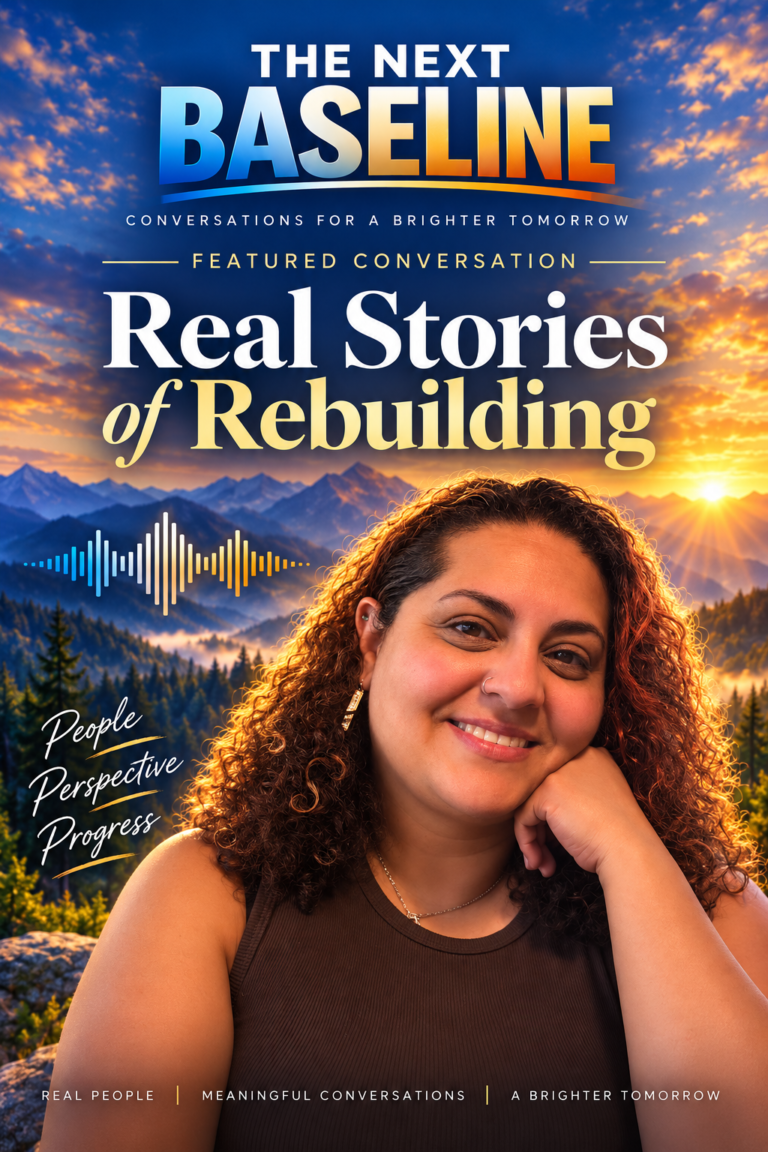
“You’re never too old to start something new. There’s always an opportunity to start anew.”
Debbie DeJesus
Featured Guest: Debbie DeJesus
There are versions of our lives we begin constructing long before we understand how little control we will have over whether they actually happen.
Marriage will work. Children will come. Careers will progress. Money will eventually sort itself out. Adulthood will arrive with some invisible package of competence, stability, and certainty that we assume everyone else received before us.
Then life happens.
For Debbie DeJesus, that imagined sequence fractured in several places. A marriage that began in her early twenties eventually ended after 12 years. Financial stability took far longer to build than she expected. Much of her twenties and early thirties included caring for her grandmother rather than establishing the kind of independent adulthood she might otherwise have experienced. And perhaps most painfully, seven miscarriages eventually forced her to confront a future in which motherhood would not unfold the way she once believed it would.
Her story is not remarkable because everything eventually became easy.
It is remarkable because she had to learn how to build a meaningful life without waiting for the original version of that life to return.
When Love Is Not Enough
Debbie married young.
She met the man who would become her husband through MySpace at a time when social media itself was still relatively new. They shared interests, connected quickly, and, from the perspective of someone in her early twenties who had little relationship experience, what they had felt like love.
Years later, she can see something her younger self could not fully understand: loving someone and knowing how to build a life with them are not the same skill.
Marriage introduced finances, household responsibilities, mental health challenges, caregiving demands, and expectations neither of them was fully prepared to navigate. Debbie describes reaching periods when even buying groceries became difficult. She had not been taught how to budget, save, or invest, and the financial strain did not exist separately from the marriage. It became part of the environment in which the relationship was trying to survive.
Meanwhile, another responsibility was shaping her adulthood. After her grandmother was injured, Debbie moved closer and became one of her caregivers. What might traditionally have been years spent establishing independence became years of balancing a marriage, work, financial pressure, and the needs of someone she loved.
Eventually, Debbie and her husband purchased a home. But a new address could not resolve what had accumulated inside the relationship.
By the time the COVID-19 pandemic forced even more proximity, she describes a marriage that had begun to feel less like a partnership and more like two people occupying the same space. The question was no longer whether she loved the person she had married.
It was whether she could continue living this version of her life for another ten or twenty years.
That distinction matters.
Her story is not an argument that difficulty should end a marriage. Debbie stayed for more than a decade and is explicit that relationships capable of being repaired deserve that effort. Her realization came after years of trying, carrying responsibilities she increasingly experienced as one-sided, and recognizing that the life she was living had become unsustainable.
Sometimes confrontation begins when the question changes from Can I endure this? to Should I continue to?
Grieving More Than One Future
The end of Debbie’s marriage was only one form of loss.
She had already become familiar with grief much earlier in life. She spoke about significant family losses during adolescence, an unconventional childhood, and eventually the death of her grandmother. But there was another grief that carried a different weight.
Debbie was diagnosed with polycystic ovarian syndrome as a teenager. Over the years, she became pregnant several times.
She also miscarried seven times.
She remembers the seventh with particular clarity: waking in the middle of the night, the physical pain, the blood, and the realization that she was experiencing another loss that had begun to feel almost familiar while never actually becoming ordinary.
That contradiction is difficult to explain to someone who has never lived it.
Repetition can change how a person responds to grief without making the grief insignificant. Debbie remembers becoming increasingly accustomed to miscarriage while still preserving reminders of what had happened because, to her, these were not simply medical events.
They represented children she would never meet.
Eventually, there was another truth to confront: motherhood was unlikely to become part of her life in the way she once imagined.
Grief in that context is larger than mourning what happened. It includes mourning what will not happen.
There will be no first day of school.
No watching that child discover who they are.
No relationship between mother and adult son or daughter decades later.
The loss extends into a future that existed only in imagination, but that does not make the future emotionally unreal.
Debbie found ways to carry that grief rather than pretend it had disappeared. She found comfort in something she encountered about fetal cells potentially remaining within a mother after pregnancy, an idea that allowed her to feel that some physical connection to the children she lost remained with her. She poured enormous affection into her animals, referring to her cats as her children and grieving deeply when some of them died.
None of those things replace motherhood.
That is not the point.
The point is that human beings have an extraordinary ability to continue creating attachment, care, meaning, and love even after one particular expression of those things becomes unavailable.
The Uncomfortable Silence After Everything Changes
Divorce created another experience Debbie had rarely encountered:
Silence.
She had lived with family. She had lived with her husband. She had spent years caring for someone else. Suddenly, she found herself alone in an apartment with no one in the next room and no relationship dictating the rhythm of her days.
At first, she describes that quiet as eerie.
Then something changed.
The silence that initially represented absence began creating room.
She could arrange her home the way she wanted. Take care of her plants. Care for her cats. Exercise. Drive to the shore. Try something new without negotiating the decision with another person. For perhaps the first time, she had to develop a relationship with herself rather than understand herself primarily through her relationship to someone else.
This is where her story begins to mirror the Realignment stage of C2R2E.
Collapse reveals that the previous operating system can no longer sustain the life being lived. Confrontation requires seeing that reality without disguising it. Realignment then asks a much harder question:
If the old life is gone, what matters now?
Debbie did not answer that question in a weekend.
She estimates that several years passed between her divorce at 36 and the point around 38 or 39 when she began feeling genuinely secure in her independence.
That matters because transformation is often misrepresented as an event.
It is usually closer to accumulation.
One quiet evening.
One financial decision.
One boundary.
One therapy appointment.
One new habit.
One moment when being alone stops feeling like abandonment and begins feeling like ownership of your own life.
Reclaiming the Parts of Herself That Had Been Waiting
By her late thirties, Debbie began deliberately experimenting with what else her life could contain.
She used Elevatus’ 7-Day Reset during this period and describes it as one of the experiences that helped interrupt the patterns she had been living inside. The program did not resolve years of grief in seven days, nor was that its purpose. For Debbie, it created enough perspective to begin asking different questions about what she wanted to do with the life now in front of her.
She also entered talk therapy.
The distinction she makes between the two is important. Coaching helped her consider possibilities, perspective, direction, and the person she could become. Therapy gave her a place to unload emotional pain she had accumulated over years and examine wounds that required something different from goal setting or personal development.
The two served different functions.
Together, they became part of a larger reclamation.
Debbie began writing music rather than simply performing covers. She started learning piano. She allowed herself to be a beginner again at an age when many people begin quietly abandoning new ambitions because they believe they should already know who they are.
Then her career changed.
She had worked as a paralegal for years, building experience across areas including landlord-tenant, family, municipal, and eventually personal injury law. Despite years of relatively modest earnings, she stayed connected to the profession and believed there was more available to her within it.
An attorney she knew eventually invited her to work in personal injury.
She was hesitant. It was unfamiliar. The deadlines intimidated her. She did not have experience in that specialty.
She said yes anyway.
The opportunity changed her financial life.
Working across two legal practices gave her the income to eliminate her credit card balances, pay off her vehicle, reduce debt, and experience something that had once seemed distant: the ability to buy groceries without calculating whether doing so would create another financial crisis before the end of the month.
The woman who once said she could not budget “to save her life” had become financially independent.
Not because adulthood finally arrived and handed her the answers.
Because she learned them.
A Different Relationship With Love
Reclamation also changed how Debbie approached relationships.
She eventually met Josh through the music community she had entered after her divorce. The irony is difficult to miss: one of the relationships that became meaningful to her emerged while she was pursuing something that belonged entirely to herself.
Their relationship has been largely long-distance, requiring trust, communication, boundaries, planning, and patience.
For an earlier version of Debbie, distance might have felt threatening.
For the woman who learned to live alone, it has allowed something different.
Two independent people can maintain their own lives while intentionally choosing a relationship with one another.
That does not mean old patterns never surface. Debbie openly described moments when her previous experiences affected how she responded in the new relationship. The difference is that she now recognizes those moments and has tools for addressing them rather than assuming that love itself will resolve them.
She is not trying to recreate her first marriage correctly.
She is building a different kind of relationship from a different version of herself.
The Life That Is Actually Here
Near the end of our conversation, Debbie offered a simple observation:
You are never too old to start something new.
At 40, she is learning piano.
She is writing music.
She has expanded her legal career.
She has rebuilt her finances.
She is in a relationship structured differently from the marriage that preceded it.
She has learned how to live independently.
And she still carries grief.
That final piece is important because transformation does not require rewriting the past into something beautiful.
Seven miscarriages do not become good because something meaningful happened later.
A difficult marriage does not become necessary simply because wisdom emerged from it.
Years of financial anxiety do not need to be romanticized.
C2R2E does not ask us to pretend Collapse was secretly a gift. It asks what we will do once reality has made itself impossible to ignore.
Confront it.
Realign.
Reclaim.
And eventually, begin living from a new baseline.
Debbie’s life today does not resemble the future her younger self once imagined.
That future included a different marriage, children, and perhaps a much earlier sense that adulthood had finally clicked into place.
None of it happened that way.
Yet there is still music.
There is meaningful work.
There is love.
There is independence.
There is financial stability.
There are plants, cats, travel, creativity, family, and the possibility of becoming someone she could not have imagined at 20.
Perhaps that is one of the more difficult truths about rebuilding a life.
We can spend years measuring what exists against what was supposed to exist.
Or we can eventually ask a different question:
What can I build with the life that is actually here?
That question does not erase grief.
It simply refuses to give grief the final word.
Listen to the Full Conversation
This Elevatus Editorial accompanies a conversation with Debbie DeJesus on The Next Baseline, exploring divorce, miscarriage and the loss of an imagined future, financial reclamation, solitude, therapy, creativity, career growth, and what it means to rebuild adulthood when life unfolds differently than expected.
 Listen to the full episode below.
🔄Did you find this article helpful? Share it!

About the Author - Danny DeJesus
Danny De Jesus is a transformational resilience thought leader, strategic thinker, and the founder of Elevatus Coaching—a practice built to help people rebuild their lives after major change. Drawing from his own experiences with divorce, co-parenting, and career shifts, he created the C2R2E Framework to guide people from collapse to elevation with clarity and confidence. Through the Elevatus Blog, he shares insights for anyone navigating disruption, rebuilding direction, or shaping a new chapter with purpose.